

Official travel carries a different weight than personal or commercial trips. When a visa application is submitted on behalf of a government department, an NGO, or a corporate delegation, embassies expect a level of structure, authority, and clarity that goes beyond a standard business or tourist explanation. This is where an official delegation visa cover letter becomes central to the application.
Unlike informal travel letters, an official visa cover letter does not attempt to persuade. Its role is to confirm legitimacy who is traveling, in what official capacity, for what purpose, and under whose authorization. When written correctly, it allows visa officers to verify details quickly and assess the application without unnecessary follow-up.
This article explains how to prepare a delegation visa cover letter that meets embassy expectations across countries, while remaining precise, professional, and document-aligned.
Why official visa cover letters are reviewed differently.
Visa officers approach official and delegation files with a different lens. These applications are often time-sensitive, linked to conferences, bilateral meetings, training programs, or institutional visits. Because they involve organizations rather than individuals alone, embassies focus heavily on authorization, sponsorship, and accountability.
An effective delegation visa cover letter answers three core questions immediately:
Who authorized the travel? Why is the travel official? Who takes responsibility for costs and return?
If any of these elements are unclear, even well-documented applications may be delayed.
When an official or delegation visa cover letter is required.
An official cover letter is appropriate when travel is undertaken in an institutional capacity. This includes government officials attending meetings abroad, NGO representatives participating in conferences or field coordination, and corporate teams traveling on formal assignments, audits, or policy engagements.
It should not be used for personal travel, even if the traveler works for a government or organization. Misclassifying a private trip as “official” is a common error that weakens credibility and may trigger closer scrutiny.
The role of authority and official capacity.
One of the defining features of an official visa cover letter is how clearly it establishes authority. The letter should leave no doubt that the travel has been approved by a competent organization and that the applicant is traveling as a delegation member or official representative, not as an individual acting independently.
This is why embassies often expect such letters to be issued on organizational letterhead and signed by an authorized signatory. Titles, roles, and department names must match employment letters, identification documents, and authorization notes exactly.
Core structure of an official visa cover letter.
While formats vary slightly between embassies, a globally accepted structure exists. A strong letter begins with clear identification of the applicant and the organization, followed by a concise explanation of the official purpose of travel. It then references the host organization or event, confirms travel dates and locations, and clearly states who is responsible for funding.
The closing section should confirm the temporary nature of the visit and the applicant’s return to official duties. The letter should also reference attached supporting documents rather than repeating their content.
How to write the letter: a narrative approach.
Begin the letter by establishing official capacity. This should be done calmly and factually, without embellishment. For example, stating that the applicant is traveling as a designated representative of an organization immediately frames the application correctly.
Next, explain the purpose of travel. This section should reference the event, meeting, or program by name and connect it to the applicant’s role. Avoid vague descriptions such as “official meetings” or “professional engagement.” Instead, refer to agendas, symposiums, training programs, or bilateral discussions already documented elsewhere in the file.
Funding responsibility must be addressed clearly and without ambiguity. Embassies want to know whether the organization, the host, or the individual covers travel and accommodation. This is not a place for flexible wording. Precision reduces questions.
Finally, confirm the return schedule. Even for high-level delegations, embassies must be assured that the visit is temporary and that the applicant will return to their institutional role.
Single traveler vs. multi-member delegations.
When a delegation includes multiple members, the cover letter should remain concise. Rather than listing all names and passport numbers in the body, it is more effective to reference a separate annex or delegation list. This keeps the letter readable while still providing complete information.
For single travelers, more detail can be included directly in the letter, as long as it remains within one page.
A common delegation mistake.
A corporate delegation once submitted an official visa application with a well-written letter, but the signatory was a senior manager rather than an authorized director. Although all documents were present, the embassy requested clarification, delaying the entire delegation’s travel. The issue was resolved by reissuing the same letter, unchanged in content, but signed by the correct authority. The lesson is simple: authority matters as much as wording.
Sponsorship and funding: say it once, say it clearly.
Funding statements should be brief and unambiguous. Whether expenses are covered by the sending organization, the host, or split between both, this must be stated explicitly. Avoid language that suggests uncertainty or future arrangements.
Document alignment matters more than length.
Embassies read official cover letters alongside invitation letters, agendas, authorization notes, and employment proof. Dates, titles, and locations must align perfectly across all documents. Even minor inconsistencies can raise questions.
The table below illustrates how cover letter statements should align with supporting documents.
| Cover Letter Reference | Supporting Document |
| Purpose of travel | Invitation letter / agenda |
| Official role | Employment or HR letter |
| Travel dates | Invitation and itinerary |
| Funding responsibility | Authorization or sponsor letter |
| Return plan | Assignment or duty confirmation |
Common errors and how to avoid them
Many delegation applications fail not because of missing documents, but because of unclear presentation. Common issues include vague agendas, missing funding statements, incorrect signatories, and overlong letters that repeat attached documents.
The solution is restraint. A strong official visa cover letter or delegation visa cover letter explains just enough to guide the reviewer, and no more.
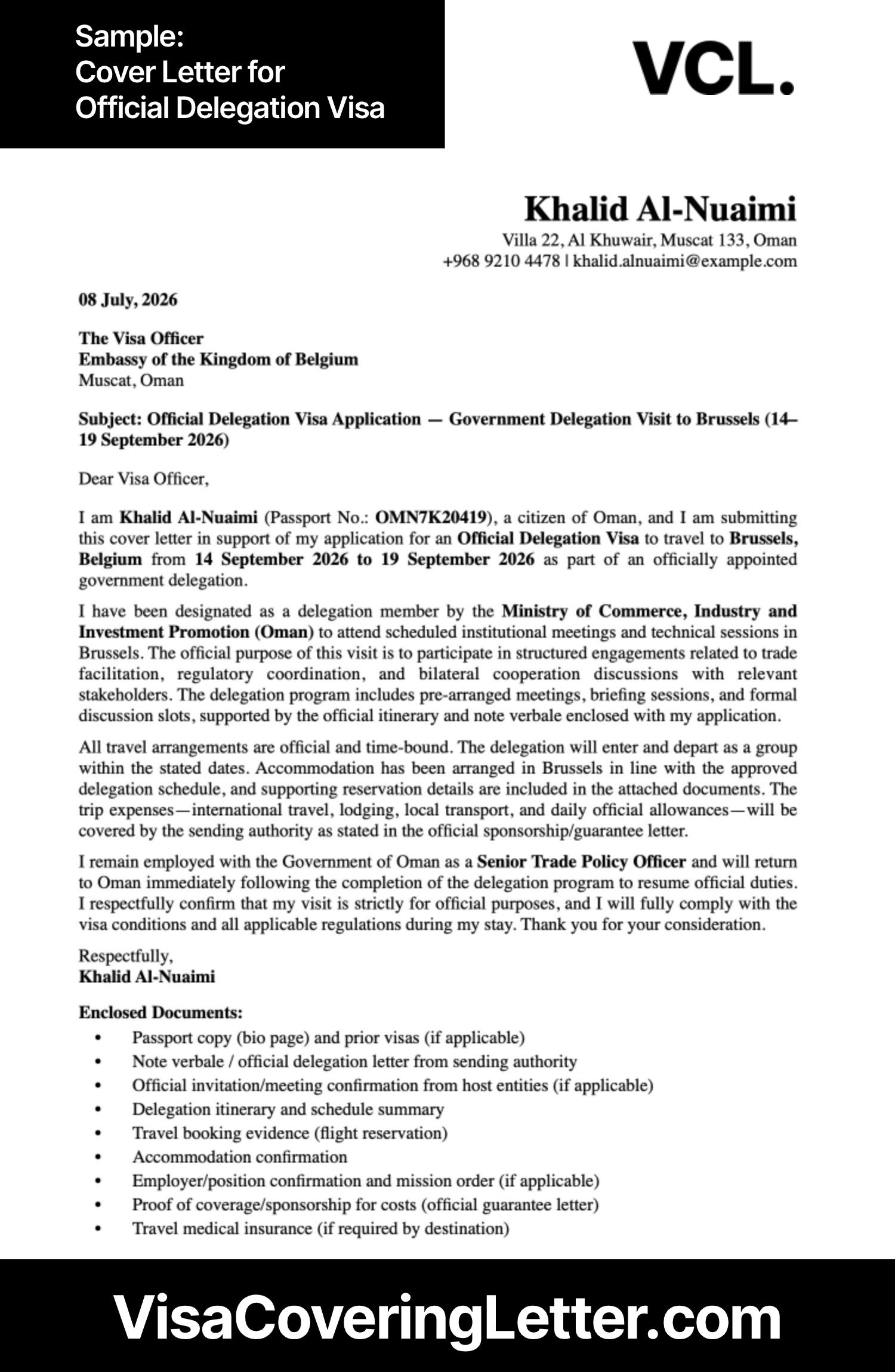
Cover letter for official delegation visa sample:
Khalid Al-Nuaimi
Villa 22, Al Khuwair, Muscat 133, Oman
+968 9210 4478 | khalid.alnuaimi@example.com
08 July, 2026
The Visa Officer
Embassy of the Kingdom of Belgium
Muscat, Oman
Subject: Official Delegation Visa Application — Government Delegation Visit to Brussels (14– 19 September 2026)
Dear Visa Officer,
I am Khalid Al-Nuaimi (Passport No.: OMN7K20419), a citizen of Oman, and I am submitting this cover letter in support of my application for an Official Delegation Visa to travel to Brussels, Belgium from 14 September 2026 to 19 September 2026 as part of an officially appointed government delegation.
I have been designated as a delegation member by the Ministry of Commerce, Industry and Investment Promotion (Oman) to attend scheduled institutional meetings and technical sessions in Brussels. The official purpose of this visit is to participate in structured engagements related to trade facilitation, regulatory coordination, and bilateral cooperation discussions with relevant stakeholders. The delegation program includes pre-arranged meetings, briefing sessions, and formal discussion slots, supported by the official itinerary and note verbale enclosed with my application.
All travel arrangements are official and time-bound. The delegation will enter and depart as a group within the stated dates. Accommodation has been arranged in Brussels in line with the approved delegation schedule, and supporting reservation details are included in the attached documents. The trip expenses—international travel, lodging, local transport, and daily official allowances—will be covered by the sending authority as stated in the official sponsorship/guarantee letter.
I remain employed with the Government of Oman as a Senior Trade Policy Officer and will return to Oman immediately following the completion of the delegation program to resume official duties. I respectfully confirm that my visit is strictly for official purposes, and I will fully comply with the visa conditions and all applicable regulations during my stay. Thank you for your consideration.
Respectfully,
Khalid Al-Nuaimi
Enclosed Documents:
- Passport copy (bio page) and prior visas (if applicable)
- Note verbale / official delegation letter from sending authority
- Official invitation/meeting confirmation from host entities (if applicable) • Delegation itinerary and schedule summary
- Travel booking evidence (flight reservation)
- Accommodation confirmation
- Employer/position confirmation and mission order (if applicable)
- Proof of coverage/sponsorship for costs (official guarantee letter)
- Travel medical insurance (if required by destination)
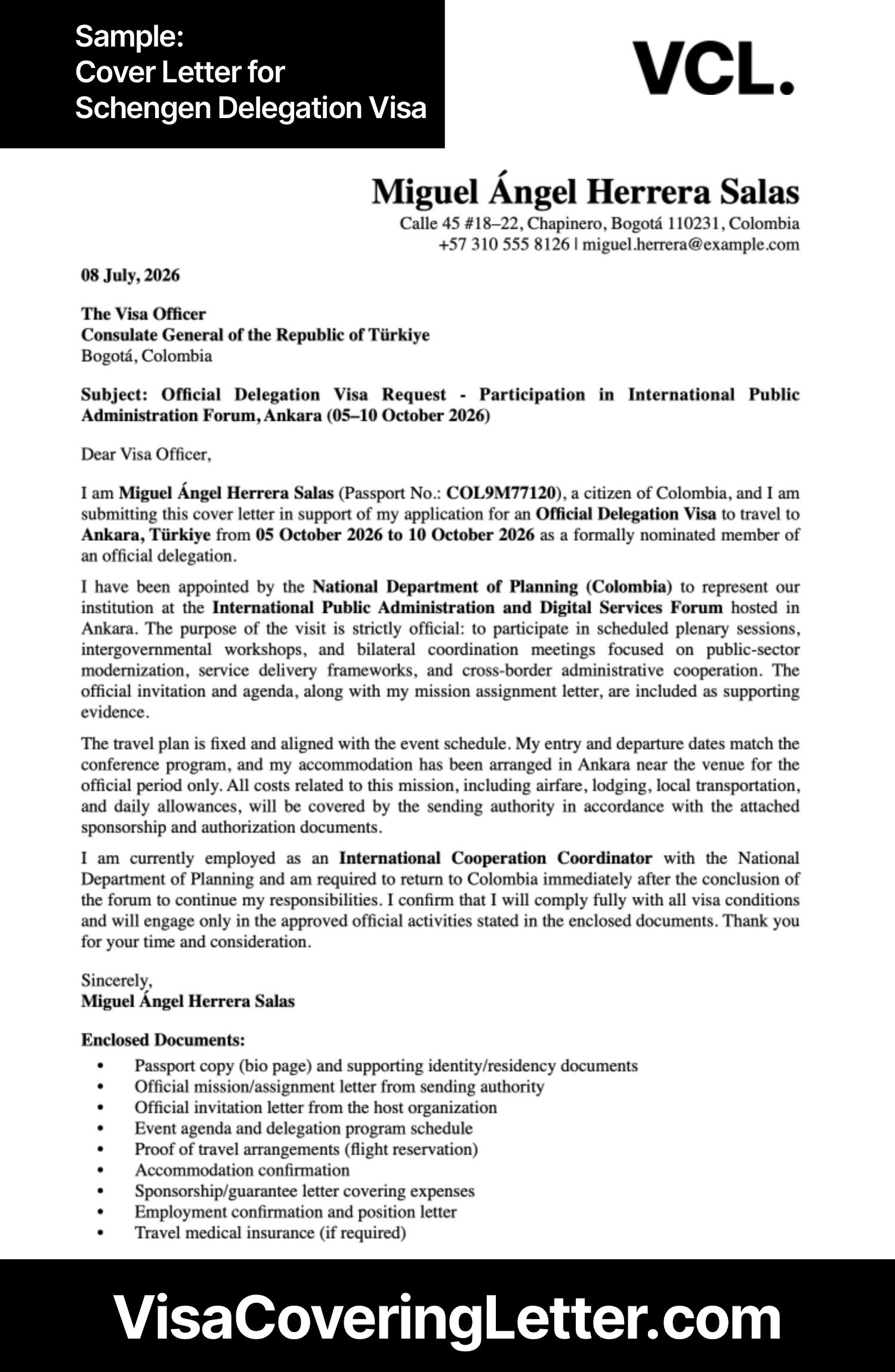
Schengen visa cover letter sample for official delegation:
Miguel Ángel Herrera Salas
Calle 45 #18–22, Chapinero, Bogotá 110231, Colombia
+57 310 555 8126 | miguel.herrera@example.com
08 July, 2026
The Visa Officer
Consulate General of the Republic of Türkiye
Bogotá, Colombia
Subject: Official Delegation Visa Request – Participation in International Public Administration Forum, Ankara (05–10 October 2026)
Dear Visa Officer,
I am Miguel Ángel Herrera Salas (Passport No.: COL9M77120), a citizen of Colombia, and I am submitting this cover letter in support of my application for an Official Delegation Visa to travel to Ankara, Türkiye from 05 October 2026 to 10 October 2026 as a formally nominated member of an official delegation.
I have been appointed by the National Department of Planning (Colombia) to represent our institution at the International Public Administration and Digital Services Forum hosted in Ankara. The purpose of the visit is strictly official: to participate in scheduled plenary sessions, intergovernmental workshops, and bilateral coordination meetings focused on public-sector modernization, service delivery frameworks, and cross-border administrative cooperation. The official invitation and agenda, along with my mission assignment letter, are included as supporting evidence.
The travel plan is fixed and aligned with the event schedule. My entry and departure dates match the conference program, and my accommodation has been arranged in Ankara near the venue for the official period only. All costs related to this mission, including airfare, lodging, local transportation, and daily allowances, will be covered by the sending authority in accordance with the attached sponsorship and authorization documents.
I am currently employed as an International Cooperation Coordinator with the National Department of Planning and am required to return to Colombia immediately after the conclusion of the forum to continue my responsibilities. I confirm that I will comply fully with all visa conditions and will engage only in the approved official activities stated in the enclosed documents. Thank you for your time and consideration.
Sincerely,
Miguel Ángel Herrera Salas
Enclosed Documents:
- Passport copy (bio page) and supporting identity/residency documents
- Official mission/assignment letter from sending authority
- Official invitation letter from the host organization
- Event agenda and delegation program schedule
- Proof of travel arrangements (flight reservation)
- Accommodation confirmation
- Sponsorship/guarantee letter covering expenses
- Employment confirmation and position letter
- Travel medical insurance (if required)
Who this approach is best for.
This structure is best suited for government officials, NGO representatives, and corporate employees traveling under formal authorization. It is not suitable for personal travel, informal networking trips, or tourism combined with professional activities.

Frequently asked questions.
What is a delegation visa cover letter?
It is a formal letter confirming official capacity, purpose, and institutional responsibility for travel.
Who should sign it?
An authorized signatory of the organization or department.
Can one letter cover multiple travelers?
Yes, with a separate annex listing delegation members.
Is an invitation letter required?
In most official cases, yes.
Does it guarantee approval?
No. It improves clarity but does not guarantee outcomes.
Conclusion.
A well-written official visa cover letter establishes authority, purpose, and responsibility in a single, coherent narrative. Keep it formal, aligned with documents, and focused on official capacity clarity, not volume, is what supports a smooth review.