
An Estonia visa file can contain every expected document and still make the reviewer work too hard. A flight itinerary shows movement. Hotel confirmations account for accommodation. A bank statement records financial activity. An invitation identifies a host or organisation. An employment certificate confirms a professional position. Yet none of those records automatically explains why Estonia is the correct country to examine the application, how the journey fits together, who is paying for each part, or why the declared purpose is credible.
That is the useful role of a cover letter for Estonia visa submission. It acts as the file’s narrative map. It does not manufacture eligibility, repair weak evidence or promise approval. It arranges genuine information so that the reader can understand the application without reconstructing the applicant’s intentions from scattered attachments.
Estonia rewards precision in the same way any well-administered visa system does. Dates should reconcile. The principal destination should be defensible. The visa category should fit the activity. Accommodation should cover the relevant nights. Financial claims should correspond with records. Temporary visitors should explain their return circumstances without theatrical promises. Applicants seeking long-stay employment should use the correct national procedure rather than disguising work as tourism or business travel.
This guide approaches the letter as an evidence-control document rather than a ceremonial introduction. It explains who generally needs a visa, how Estonia’s role in a multi-country journey should be established, what content belongs in the letter and how six different purposes alter its logic. The sample letters are intentionally incomplete demonstrations. They cannot be edited into acceptable applications and do not replace a personalized document prepared from the applicant’s actual facts.
The Estonia Cover Letter Has One Central Job: Remove Ambiguity
Many applicants try to make a visa letter “strong” by making it emotional, lengthy or excessively formal. That usually solves the wrong problem. A reviewing officer does not need admiration for Tallinn, repeated assurances of honesty or dramatic statements about returning home. The officer needs an intelligible account that can be tested against the supporting file.
A useful Estonia visa application letter answers a compact set of questions:
- Who is applying, and what permission is being requested?
- What is the genuine principal purpose of the journey?
- Why is Estonia the sole or main destination responsible for the application?
- What are the intended arrival, movement and departure dates?
- Where will the applicant stay for every relevant night?
- Who will meet the transport, accommodation and daily expenses?
- Which documents substantiate those claims?
- For a short visit, what circumstances support departure before the authorised stay ends?
- Is there any unusual point that would otherwise appear inconsistent?
The cover letter should make those answers easy to locate. It should not compete with the application form or reproduce every line from a booking. Its value lies in connection: purpose connected to invitation, itinerary connected to accommodation, funding connected to evidence, and intended return connected to continuing responsibilities.
What a cover letter can and cannot do
| A well-prepared cover letter can | A cover letter cannot |
| identify the requested visa and principal purpose | guarantee that a visa will be granted |
| explain why Estonia is the competent destination | make Estonia competent when the real main destination is elsewhere |
| reconcile a multi-city or multi-country route | validate bookings that are false, cancelled or contradictory |
| distinguish self-funding from host or employer support | replace bank records, sponsorship evidence or an employer undertaking |
| clarify a genuine irregularity or previous change | conceal a material fact or cure an untruthful application |
| guide the reviewer to the relevant attachments | substitute for mandatory documents on the current checklist |
| present temporary return circumstances coherently | prove return intent through unsupported promises alone |
This distinction also matters when applicants encounter phrases such as “Estonia visa approval letter” online. A private cover-letter service does not issue an approval and cannot influence the decision-maker. The responsible meaning of an “approval tip” is a presentation practice that reduces avoidable confusion not a shortcut, guarantee or secret formula.
Who Generally Needs a Visa to Travel to Estonia?
Estonia is part of the Schengen Area. For an ordinary short visit, the passport presented—not merely the applicant’s place of residence—usually determines whether a Schengen visa is required. The consolidated EU visa list currently places the following countries and territorial authority in the visa-required category for ordinary passport holders. The grouping below is for readability rather than legal classification.
| Region | Countries whose nationals generally require a short-stay Schengen visa |
| Africa | Algeria, Angola, Benin, Botswana, Burkina Faso, Burundi, Cabo Verde, Cameroon, Central African Republic, Chad, Comoros, Congo, Côte d’Ivoire, Democratic Republic of the Congo, Djibouti, Egypt, Equatorial Guinea, Eritrea, Eswatini, Ethiopia, Gabon, The Gambia, Ghana, Guinea, Guinea-Bissau, Kenya, Lesotho, Liberia, Libya, Madagascar, Malawi, Mali, Mauritania, Morocco, Mozambique, Namibia, Niger, Nigeria, Rwanda, São Tomé and Príncipe, Senegal, Sierra Leone, Somalia, South Africa, South Sudan, Sudan, Tanzania, Togo, Tunisia, Uganda, Zambia, Zimbabwe |
| Asia | Afghanistan, Bangladesh, Bhutan, Cambodia, China, India, Indonesia, Laos, Maldives, Mongolia, Myanmar, Nepal, North Korea, Pakistan, Philippines, Sri Lanka, Thailand, Vietnam |
| Middle East | Bahrain, Iran, Iraq, Jordan, Kuwait, Lebanon, Oman, Qatar, Saudi Arabia, Syria, Yemen and holders of travel documents issued by the Palestinian Authority, subject to the applicable rules |
| Europe and Eurasia | Armenia, Azerbaijan, Belarus, Kazakhstan, Kyrgyzstan, Russia, Tajikistan, Türkiye, Turkmenistan, Uzbekistan |
| Americas and Caribbean | Belize, Bolivia, Cuba, Dominican Republic, Ecuador, Guyana, Haiti, Jamaica, Suriname |
| Oceania | Fiji, Papua New Guinea, Vanuatu |
This list is a starting point, not a substitute for checking the rules that apply on the filing date. Passport type, a qualifying residence card, EU free-movement rights, family-member status and other exemptions can change the answer. Visa-waiver arrangements can also be amended. An applicant should therefore verify the current official list and the instructions of the Estonian mission or representing Schengen state before paying for services or arranging an appointment.
Being a national of a visa-required country does not mean that every application must include an independently drafted cover letter. Local harmonised checklists vary, and a consulate may request additional material. Even where the cover note is optional, however, it can be useful when the journey has several destinations, mixed funding, private accommodation, a previous refusal, an unusual account transaction or another point that needs a concise explanation.
Confirm That Estonia Is the Correct Country for the Application
A polished letter addressed to the wrong Schengen state remains a wrongly directed application. Before writing, establish consular competence.
If Estonia is the only Schengen destination, the position is usually straightforward. If the itinerary covers more than one Schengen state, the competent state is generally the one that forms the main destination by purpose or length of stay. If no main destination can be identified, responsibility generally falls to the state whose external border the applicant will cross first. Applications are ordinarily lodged in the applicant’s country of lawful residence.
The first airport is not automatically the main destination. A traveller who changes aircraft in Frankfurt and spends eight nights in Estonia does not usually apply to Germany merely because the first landing is there. Conversely, an applicant who spends two nights in Tallinn and ten nights in Finland should not present Estonia as the main destination simply because the flight arrives there first.
The cover letter should make Estonia’s role visible when the route is not obvious. A useful sentence might explain that Estonia accounts for the longest stay, that the decisive business event takes place in Tallinn, or that the journey’s primary academic programme is hosted in Tartu. That statement must agree with the hotel nights, invitation, activity schedule and application form.
Representation arrangements require an extra check
Estonia does not receive every visa application through an Estonian embassy in every country. Depending on the applicant’s country of lawful residence, another Schengen state may represent Estonia, or an external service provider may receive the documents for the competent mission. These arrangements can change.
Do not copy an embassy address from an old blog article. Verify the live route for the applicant’s residence country, then place the correct authority’s name and address above the subject line. A visa application centre may collect documents, while the diplomatic or consular authority remains responsible for the assessment. The letter should be addressed in accordance with the current local instructions rather than assuming that the collection centre is the decision-maker.
Separate the Visa Category from the Travel Theme
“Tourist,” “business,” “medical” and “family visit” describe purposes. “Short-stay C visa” and “long-stay D visa” describe legal visa routes. These ideas overlap, but they are not interchangeable.
A Schengen C visa concerns stays of no more than 90 days in any 180-day period, subject to the validity, entries and duration actually granted. It may support tourism, visiting relatives, short business activity, medical care, cultural participation, sports or qualifying brief study. It is not a general permission to take employment.
An Estonian D visa is a national long-stay visa for a temporary stay in Estonia and can, where applicable, be issued for a longer period. Employment, longer studies, teleworking and other long-stay purposes can require the D-visa or residence-permit framework, with purpose-specific evidence. A person going to work must describe the real activity and follow the applicable employment registration and immigration requirements.
| Proposed activity | Likely writing focus | Important distinction |
| Holiday in Tallinn, Tartu or elsewhere in Estonia | route, accommodation, personal funding, temporary absence | sightseeing does not justify undisclosed work |
| Meetings, conference or trade event | invitation, role, agenda, payer, professional return | attending meetings is not the same as performing local employment |
| Staying with relatives or friends | relationship, host address, expense division, duration | accommodation support does not automatically equal full sponsorship |
| Scheduled medical care | provider confirmation, treatment period, payment, companion | wellness tourism should not be labelled medical treatment |
| Short course, cultural programme or sports event | admission or invitation, dates, role, costs, continuing commitments | longer study may require a national route |
| Employment in Estonia | employer, position, work registration or permission, planned residence | a work-related D visa letter is not a job-seeker cover letter |
The applicant should settle the category before drafting. A letter cannot safely blur two different purposes in the hope that one of them will be accepted. If the trip legitimately combines activities such as a conference followed by two leisure days, the principal purpose should remain clear, and the secondary activity should be explained in proportion.
Build an “Evidence Spine” Before Writing the First Paragraph
An original Estonia Schengen visa cover letter begins outside the document. First, reduce the application to a one-page evidence spine: a private planning sheet that records each important claim, its supporting record and any mismatch that still needs resolution.
| Claim to be made | Evidence that should support it | Questions to resolve before drafting |
| Estonia is the main destination | hotel nights, invitation, event or course schedule | Does another country have more days or the stronger purpose? |
| Travel dates are fixed | flight or transport reservation, leave approval, programme dates | Do departure and arrival dates differ because of overnight travel? |
| Accommodation covers the visit | hotel confirmations, host evidence, rental or institutional lodging | Is every night accounted for without overlap? |
| The applicant can fund the trip | bank history, salary, business income, sponsor or employer documents | Who pays each category, and are the funds genuinely accessible? |
| The applicant will leave after a short stay | employment, study, business, residence or family circumstances | Which continuing commitments are documented rather than merely asserted? |
| The selected purpose is accurate | invitation, tickets, treatment or enrolment records | Does the planned activity require a different visa or permission? |
This method prevents a common drafting failure: elegant prose being written around facts that have not yet been reconciled. If the hotel ends one day before the outbound flight, the solution is not softer wording. The itinerary or accommodation evidence must be corrected or truthfully explained. If the applicant claims employer funding but the company letter covers only conference registration, the funding arrangement needs clarification before the personal letter is finalised.
The evidence spine also keeps the cover letter proportionate. Straightforward facts can receive one sentence. A material inconsistency may need a short explanatory paragraph and a supporting attachment. Not every document deserves equal space simply because it appears in the file.
The Seven Consistency Tests for an Estonia Visa Application Letter
- The purpose test
The opening should identify the real reason for travel without borrowed enthusiasm. “I am applying for a short-stay visa to attend the Baltic Data Governance Forum in Tallinn” is informative. “Estonia is my dream destination and I promise to respect every law” does not tell the reviewer what the visit involves.
The wording should follow the primary evidence. A business invitation determines the meeting purpose. A hospital or clinic confirmation defines the medical arrangement. A university letter establishes the academic programme. The applicant can provide context, but should not enlarge the activity beyond what the issuing organisation has confirmed.
When two motives coexist, state which one governs the trip. A visitor attending a cousin’s wedding and spending a day sightseeing is primarily making a private visit if that is the real centre of the journey. A delegate attending a four-day industry event and remaining for a weekend can identify the business purpose and note the limited leisure extension. The label should not be chosen merely because one checklist looks easier.
- The calendar test
Create a date line from departure to return. Include overnight travel, time-zone changes, ferries and internal transfers. Then compare that line with every date in the application form, reservation, invitation, insurance, leave approval and letter.
Arrival day and first hotel check-in usually align, but not always. A late-night arrival may require accommodation on the same date; an overnight flight may mean the journey begins a day earlier than the stay. A ferry from Tallinn to Helsinki changes both the country and accommodation sequence. The cover letter can explain these points, but it should not be used to excuse an itinerary that is physically impossible.
For a short-stay visa, previous Schengen presence also matters because the maximum is calculated within a rolling 180-day period. The letter need not contain a mathematical essay, but the applicant should confirm that the requested stay fits the applicable allowance.
- The geographic test
Estonia is compact, yet an itinerary can still be illogical. Tallinn, Tartu, Pärnu, Narva, Saaremaa and smaller locations require realistic travel time. A day trip and an overnight stay are not the same thing. If the applicant sleeps in Tallinn after visiting Lahemaa National Park, the hotel record should remain in Tallinn. If the traveller spends two nights in Tartu, the accommodation and route should show that movement.
Multi-country Baltic or Nordic journeys need particular care. Tallinn–Helsinki ferry plans, Tallinn–Riga road connections and onward flights through other Schengen airports can make the first-entry country different from the main destination. The letter should distinguish transit, day visits and overnight stays. It should also avoid calling a reservation “confirmed and paid” unless that description is true.
- The funding test
State the financial arrangement as a division of responsibility rather than a vague declaration. Self-funding may cover flights, hotels and daily costs. A company may pay transport and accommodation while the employee pays personal expenses. A host may provide a room without paying for travel. A parent may support a student under a documented sponsorship arrangement.
The current general Estonian short-stay guidance uses a daily means-of-subsistence benchmark of EUR 70. This is not a magic balance that guarantees success, and official figures should be rechecked before publication or submission. Financial assessment considers the duration, purpose, accommodation arrangement and evidence showing that funds are genuinely available. A sudden unexplained deposit can attract more questions than an ordinary balance supported by stable income history.
Do not turn the cover letter into a bank ledger. Identify the payer, the cost categories and the records included. Explain only those transactions that genuinely require context. If a sponsor is involved, make the relationship and scope of support clear, and ensure the sponsor’s documents say the same thing.
- The documentary-voice test
Each document has an author. The applicant writes the personal visa cover note. The employer confirms employment, leave and any company-funded expenses. The host confirms accommodation or invitation terms. The medical provider confirms treatment. The educational institution confirms admission and programme details.
The cover letter can point to these statements but should not impersonate their authors. An applicant cannot prove an employer undertaking by writing, “My company will pay everything,” if the company has not confirmed it. Similarly, the applicant should not invent treatment language, host obligations or course conditions.
This test catches copied-template errors. Phrases such as “our employee,” “the undersigned company,” or “I invite the applicant” appearing in a personal letter often reveal that text has been pasted from a different document. Pronouns, authority and responsibility should remain clear.
- The temporary-return test
For a short visit, explain the applicant’s continuing circumstances after the journey. Useful details can include approved leave from ongoing employment, a scheduled academic term, responsibility for an operating business, lawful residence commitments or specific family responsibilities. The best point is the one that is both true and supported.
Avoid inventories of property, relatives and emotions. Owning a home is not mandatory, and a person without children can still have a credible temporary journey. “I will definitely return because I love my country” is weaker than a concise description of a documented role resuming on a particular date.
An applicant living outside their country of nationality should use precise language. The relevant return may be to the country of lawful residence. The residence permit, employment record and return itinerary should reflect that reality.
- The disclosure test
Ask what a careful reviewer could notice that the letter ignores. A previous refusal, name variation, revised itinerary, unusual financial transfer, sponsor living in a third country or gap between leave and travel dates may need explanation. Silence is not always deceptive, but it can leave a material point unresolved.
Explain proportionately and support the explanation. A previous refusal should not dominate the application; identify what was refused and what has genuinely changed, where relevant. A spelling discrepancy should be tied to the proper civil or identity record. A large deposit should be described according to its true source. Never create an explanation first and search for evidence later.
A Fresh Structure for the Estonia Visa Cover Letter
Rather than treating the letter as a fixed internet template, construct it in seven functional blocks. The length of each block should depend on the application.
Identity panel
Place the applicant’s full name, current lawful address, telephone number and email at the top. Use the spelling and order shown in the passport unless the receiving authority instructs otherwise. Add the date of the letter.
Verified recipient block
Insert the correct embassy, consulate or responsible authority and its current address above the subject. If a representing Schengen state receives Estonia applications in the applicant’s location, follow that arrangement. Do not leave a placeholder such as “[Embassy Address]” in a submitted letter.
Decision-line subject
Write a subject that tells the reader what is being requested. Examples include “Short-Stay Visa Application for a Tourism Visit to Estonia” or “Long-Stay D Visa Application for Registered Short-Term Employment.” Add dates only when they are final and consistent.
Purpose anchor
Open with identity, visa category, principal purpose and proposed duration. Mention the central invitation, programme or relationship where relevant. This paragraph should allow a reader to classify the file without searching through later pages.
Movement and accommodation account
Summarise the trip in chronological order. Identify overnight bases rather than listing every attraction. If another Schengen country appears, explain the route and Estonia’s main-destination status. Where a host provides accommodation, use the same address and terms shown in the host evidence.
Funding and continuity account
Explain who pays for what, then identify the applicant’s continuing circumstances after the short stay. These are separate issues and usually deserve separate paragraphs. A sponsor does not establish return intent; an employer does not prove access to personal spending funds unless the employer’s undertaking covers them.
Attachment map and measured close
Mention the documents that substantiate important claims and add a short, accurate enclosure list if useful. Close with a courteous request for consideration, availability for further information and the applicant’s signature as required. Do not end with pressure, desperation or a claim that the documents “guarantee” approval.
For a straightforward short visit, the finished letter is often around one or two pages, depending on local preferences and the facts needing explanation. There is no universal Estonia-specific word count that makes a cover letter acceptable. Readability and relevance matter more than filling space.
Match Every Sentence to the Supporting File
A practical final review is to label each material sentence as identity, purpose, itinerary, accommodation, funding, return circumstance or clarification. Then identify the supporting document. If a sentence makes an important factual claim but has no evidence where evidence would reasonably be expected, reconsider it.
| Cover-letter statement | Record that commonly supports it | Frequent conflict |
| “I am employed as…” | employer certificate, contract or permitted local evidence | title or start date differs across documents |
| “My leave is approved…” | signed leave confirmation | leave ends before the traveller returns |
| “I will stay with my aunt…” | invitation, host ID/status and address evidence as required | form lists a hotel instead |
| “My company will fund the trip…” | employer undertaking and company evidence | undertaking pays only event fees |
| “I will attend a course…” | admission and course schedule | programme exceeds the short-stay period |
| “Estonia is my main destination…” | nights, event purpose and route | another state dominates both time and activity |
| “I will pay from my savings…” | accessible bank history and income evidence | recent deposit is unexplained |
| “I return to resume…” | employment, studies, business or residence documents | claimed obligation has no date or support |
This exercise also keeps the writing natural. There is no reason to repeat “Estonia visa cover letter” in every paragraph. Related expressions visa application letter, supporting statement, travel cover note, letter of explanation and embassy cover letter can be used where they are precise. Choose the term that helps the reader rather than one that interrupts meaning.
Estonia-Specific Scenarios That Need Careful Explanation
Arriving through Finland, Latvia or another Schengen state
Estonia can remain the main destination even when the traveller enters the Schengen Area elsewhere. The cover letter should distinguish the external entry point from the country where the principal stay or activity occurs. State the connecting route, identify any intervening overnight stay and make sure the transport is realistic.
Do not describe a Helsinki overnight stop as a transfer if the itinerary actually includes accommodation and sightseeing there. Likewise, a same-day airport or ferry connection does not need to be inflated into a separate holiday. Accurate scale is persuasive: explain exactly what the documents show.
Using Tallinn as a base for a Baltic itinerary
A traveller might plan Tallinn, Riga and Vilnius in one journey. The country that should receive the application depends on the real main destination, not the applicant’s preferred appointment availability. Count nights carefully and consider the principal purpose. If an industry conference in Tallinn is the decisive reason for travel, Estonia may be the main destination even if the leisure nights are distributed differently; the evidence must support that conclusion. If all purposes are equal and another country has the longest stay, the cover letter should not manufacture Estonian competence.
Staying on an island or outside the major cities
Plans involving Saaremaa, Hiiumaa or rural accommodation require ordinary but precise logistics. Indicate how the traveller will reach the destination, where the relevant nights are booked and how the route connects with the international arrival and departure. Avoid inserting a remote destination simply to make the itinerary sound distinctive. Every location should serve the genuine travel plan.
Visiting an e-resident, start-up or digital-business contact
Estonian e-residency is not physical residency, a visa or a right of entry. If a business visitor is meeting a company founder who is an e-resident, describe the host’s actual legal and business role accurately. Do not imply that an e-residency card establishes the host’s residence in Estonia or gives the applicant immigration privileges.
Similarly, interest in Estonia’s digital economy does not convert tourism into a business purpose. The declared category should follow the real activities. Meetings, pitching, training, service delivery and employment may carry different implications. The invitation and the applicant’s employer letter should use compatible descriptions.
Combining a private host with hotel accommodation
Some applicants stay with a friend for part of the trip and use hotels elsewhere. The letter should divide the dates cleanly, explain which party provides each stay and keep the application form consistent. If the host offers accommodation only, do not call the arrangement “full sponsorship.” If the host also pays particular expenses, specify them and provide the evidence required by the local checklist.
A companion travelling for medical support
A medical traveller may need a relative or caregiver. Each person still has their own application circumstances. The patient’s provider confirmation should support the treatment, while the companion’s letter should explain why accompaniment is necessary, who pays and what ties support departure. One applicant’s diagnosis should not be copied indiscriminately into another person’s letter; include only relevant information with appropriate respect for privacy.
Errors That Make a Polished Letter Less Credible
Treating the cover note as a tourism advertisement
Descriptions of medieval streets, forests and Baltic sunsets do not establish eligibility. One or two destination details can make a tourism plan concrete, but the letter should remain about the applicant’s arrangements. If a paragraph could be pasted into a travel brochure without changing anything, it probably is not doing useful visa work.
Repeating the keyword instead of explaining the case
An SEO page may target “Estonia tourist visa cover letter,” but the letter inside an application is not an SEO asset. Repeating the full keyword sounds unnatural and can obscure the facts. Use ordinary formal language addressed to the reader.
Calling every document confirmed
A reservation, provisional booking, paid ticket and host invitation are not interchangeable. Describe each record according to what it is. A visa officer can inspect the attachment. Overstating its status creates an avoidable credibility problem.
Copying a financial paragraph from a stranger
The most dangerous template language often concerns money. A copied sentence may claim that the applicant is self-funding even though a parent pays, or that an employer covers all expenses when it covers only lodging. Funding language should be written only after the bank, sponsor and employer evidence has been examined together.
Hiding the second country
A flight, hotel or insurance schedule can reveal a second destination even if the cover letter does not mention it. Omission may make the filing decision appear calculated. Explain the complete Schengen route and Estonia’s role honestly.
Listing attachments that are absent or obsolete
Applicants sometimes update a reservation but leave the old reference in the cover letter. Others include a generic enclosure list copied from a checklist, even when some items do not apply. The final letter should name only the documents actually submitted and use labels the reviewer can recognise.
Confusing a business visit with employment
Meeting a partner, attending a conference and conducting negotiations can be business-visit activities. Performing productive work for an Estonian entity may require a different route. The title “business visa” does not decide the legal nature of the activity. Describe what the traveller will actually do and confirm the applicable requirements before submitting.
Writing an employment letter as though it were a holiday
An Estonia work visa cover letter should not promise a quick return merely because tourism templates contain a return paragraph. A long-stay employment applicant must explain the lawful employment and intended temporary residence under the correct procedure. The person’s compliance plans, employer details, accommodation and purpose-specific evidence replace the short-holiday narrative.
Making unsupported approval claims
No wording, font, service or sample can ensure approval. A professional letter may improve organisation and reduce contradictions, but the competent authority assesses eligibility and evidence. Responsible content should describe document quality without claiming influence over the decision.
Practical Approval Tips Without False Promises
“Approval tips” should mean controllable improvements to the submission, not myths about guaranteed outcomes. The following practices can strengthen presentation while respecting the authority’s independent decision.
Start with the local checklist, not a global template
Estonia publishes general requirements, but locally harmonised supporting-document lists can apply in particular countries. Representation arrangements also affect where and how an application is lodged. Build the file around the current instructions for the applicant’s lawful residence and purpose.
Decide the main destination before booking the narrative
Do not choose Estonia because an appointment appears convenient and then force the itinerary to fit. Settle the genuine route first. Count the nights, identify the decisive activity and verify which state is competent. The letter should record that conclusion, not create it.
Make every date pass a three-document check
Compare each key date in at least the application form, travel reservation and accommodation or invitation. Then check insurance and leave or programme records. Correct discrepancies at their source. A sentence explaining that two incompatible dates are “the same trip” rarely solves the underlying problem.
Use a funding sentence that can be audited
An effective statement identifies the payer and the categories covered. For example, employer-funded transport and lodging can be separated from personally funded daily expenses. The supporting documents should allow the reader to confirm that division.
Give unusual facts a short factual paragraph
Do not bury a genuine issue under vague language. Explain a recent account credit, changed hotel, name variation or revised route directly, attach the relevant evidence and move on. Overexplaining can look defensive; under explaining leaves a gap.
Keep the tone calm
A visa request is not a sales pitch to the embassy. Use professional courtesy, precise verbs and restrained confidence. Avoid flattery, pressure, threats, repeated pleas and claims that approval is deserved because money has already been spent.
Review the delivered or drafted letter as evidence
Professional preparation does not remove the applicant’s responsibility. Read every sentence beside the current documents. Confirm spelling, passport details, dates, addresses, host and employer names, cost allocation and route. Never submit a polished error simply because the layout looks authoritative.
Do Not Risk Your Visa Presentation with a Generic Sample
An Estonia visa application is personal. A public example cannot know the applicant’s exact purpose, passport history, route, overnight locations, funding arrangement, invitation terms, residence position or reason for returning after a short stay. It may look convenient, but adapting it means checking every sentence, replacing embedded assumptions, correcting the structure and still deciding whether the result corresponds with the evidence.
That uncertainty is why VCL. is designed for applicants who prefer a completed, personalized document instead of an editable internet shell. The letter is organised around the information supplied for the real application: travel purpose, itinerary, accommodation, financial support, documentary context and relevant return circumstances. The aim is a formal, refined presentation that explains the file rather than merely decorating it.
VCL. provides a detailed itinerary flow, clear alignment with supporting documents, professional wording, premium presentation, editable Word and PDF formats and instant email delivery at an affordable cost. The embassy address can be positioned above the subject, the date can be inserted appropriately, and the applicant can review the editable version against the final submission set.
Free examples can teach structure. They cannot deliver the finished explanation for a different person’s facts. A customized VCL. document saves the time spent rebuilding a sample and reduces the risk of leaving another traveller’s assumptions inside the application. It remains essential for the applicant to supply truthful information, verify the finished letter and comply with the latest official requirements. VCL. supports presentation; it does not determine eligibility or guarantee a visa decision.
How a Search for a Finland Visa Cover Letter Builder Led Me to VCL.
I first came across VCL. while searching for a Finland visa cover letter builder. At that stage, I thought I needed a neat template and a few formal sentences. The more I compared the draft with the actual file, the clearer the real problem became: the information existed, but it was scattered across bookings, employment evidence, financial documents and the application form.
What made the service relevant was not a promise to invent a stronger story. It was the ability to organise the story already supported by the documents. The purpose appeared early, the itinerary followed a readable sequence, accommodation was linked to the correct dates, and financial responsibility was separated into understandable parts. Receiving editable Word and PDF versions also meant that the final details could be reviewed without rebuilding the document from the beginning.
That Finland search later shaped how I approached an Estonia application. I did not carry the destination language across or rename a Finnish sample. Estonia had its own route, host information, filing authority and documentary logic. A new cover letter was necessary because a new application is not a cosmetic variation of the previous one.
The lesson was simple: a builder is useful when it turns verified personal details into an orderly explanation. It is not useful when it encourages applicants to copy broad claims or treat a different country’s sample as a universal visa letter.
Six Estonia Visa Cover Letter Types and Intentionally Non-Reusable Samples
The examples below are fictional editorial fragments. Every name, address, organisation and scenario is invented. Critical dates, recipient details, reservation particulars, funding evidence and other essential information have deliberately been removed or replaced with editorial notices. The samples are not embassy-ready, cannot become acceptable merely by changing the name, and should not be submitted to any authority.
Their purpose is to show how the centre of the explanation changes from one visa category to another. A complete application requires a letter developed from the applicant’s actual documents and the current instructions of the responsible authority.
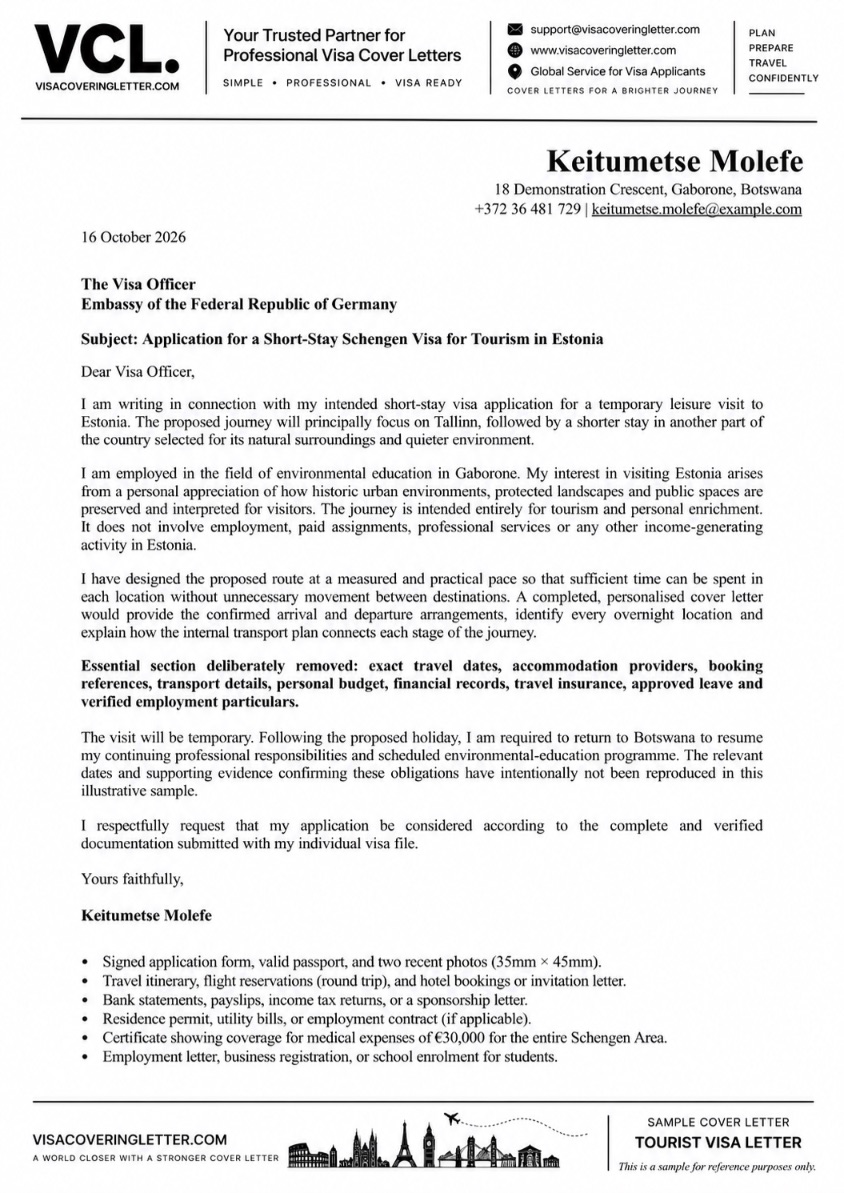
Type One: Estonia Tourist Visa Cover Letter
An Estonia tourist visa cover letter is used when leisure is the genuine principal purpose of a short visit. It should explain the travel period, Estonian destinations, overnight plan, funding and temporary nature of the absence. A plausible tourism letter selects a few meaningful activities without becoming a daily travel diary.
The example concerns a Botswanan conservation educator interested in Estonia’s urban and natural environments. That interest gives the trip an individual reason, but it does not replace bookings, funds or employment evidence. The omitted information is precisely what a real application would need.
Keitumetse Molefe
18 Demonstration Crescent, Gaborone, Botswana
+372 36 481 729 | keitumetse.molefe@example.com
16 October 2026
The Visa Officer
Embassy of the Federal Republic of Germany
Subject: Application for a Short-Stay Schengen Visa for Tourism in Estonia
Dear Visa Officer,
I am writing in connection with my intended short-stay visa application for a temporary leisure visit to Estonia. The proposed journey will principally focus on Tallinn, followed by a shorter stay in another part of the country selected for its natural surroundings and quieter environment.
I am employed in the field of environmental education in Gaborone. My interest in visiting Estonia arises from a personal appreciation of how historic urban environments, protected landscapes and public spaces are preserved and interpreted for visitors. The journey is intended entirely for tourism and personal enrichment. It does not involve employment, paid assignments, professional services or any other income-generating activity in Estonia.
I have designed the proposed route at a measured and practical pace so that sufficient time can be spent in each location without unnecessary movement between destinations. A completed, personalised cover letter would provide the confirmed arrival and departure arrangements, identify every overnight location and explain how the internal transport plan connects each stage of the journey.
Essential section deliberately removed: exact travel dates, accommodation providers, booking references, transport details, personal budget, financial records, travel insurance, approved leave and verified employment particulars.
The visit will be temporary. Following the proposed holiday, I am required to return to Botswana to resume my continuing professional responsibilities and scheduled environmental-education programme. The relevant dates and supporting evidence confirming these obligations have intentionally not been reproduced in this illustrative sample.
I respectfully request that my application be considered according to the complete and verified documentation submitted with my individual visa file.
Yours faithfully,
Keitumetse Molefe
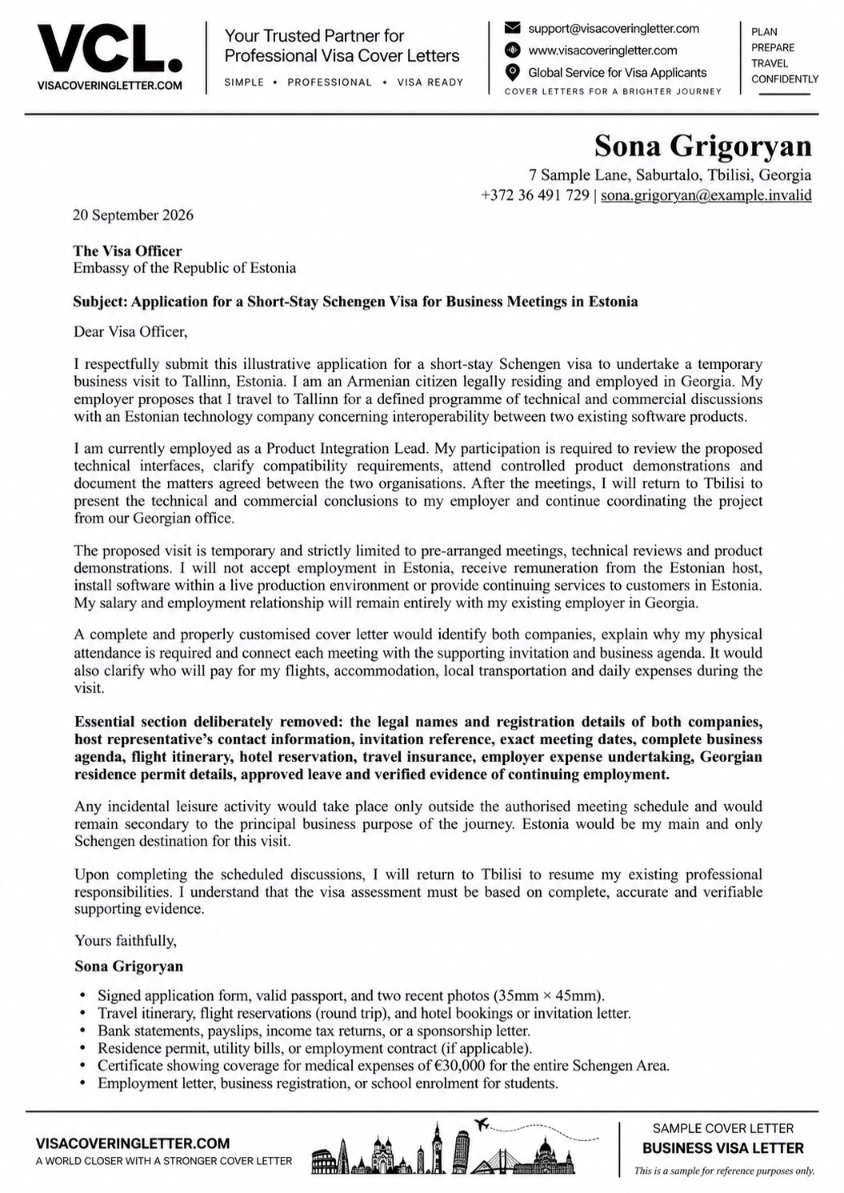
Type Two: Estonia Business Visa Cover Letter
An Estonia business visa cover letter supports a temporary commercial purpose such as meetings, negotiations, a conference or an industry event. It should identify the applicant’s role, the inviting organisation, the activity, the schedule and the expense arrangement. It must not use “business” as a vague label for undisclosed employment.
The fictional Mongolian applicant below is preparing for product-interoperability discussions with an Estonian technology company. A complete letter would need compatible statements from both companies and a clear division of costs.
Sona Grigoryan
7 Sample Lane, Saburtalo, Tbilisi, Georgia
+372 36 491 729 | sona.grigoryan@example.invalid
20 September 2026
The Visa Officer
Embassy of the Republic of Estonia
Subject: Application for a Short-Stay Schengen Visa for Business Meetings in Estonia
Dear Visa Officer,
I respectfully submit this illustrative application for a short-stay Schengen visa to undertake a temporary business visit to Tallinn, Estonia. I am an Armenian citizen legally residing and employed in Georgia. My employer proposes that I travel to Tallinn for a defined programme of technical and commercial discussions with an Estonian technology company concerning interoperability between two existing software products.
I am currently employed as a Product Integration Lead. My participation is required to review the proposed technical interfaces, clarify compatibility requirements, attend controlled product demonstrations and document the matters agreed between the two organisations. After the meetings, I will return to Tbilisi to present the technical and commercial conclusions to my employer and continue coordinating the project from our Georgian office.
The proposed visit is temporary and strictly limited to pre-arranged meetings, technical reviews and product demonstrations. I will not accept employment in Estonia, receive remuneration from the Estonian host, install software within a live production environment or provide continuing services to customers in Estonia. My salary and employment relationship will remain entirely with my existing employer in Georgia.
A complete and properly customised cover letter would identify both companies, explain why my physical attendance is required and connect each meeting with the supporting invitation and business agenda. It would also clarify who will pay for my flights, accommodation, local transportation and daily expenses during the visit.
Essential section deliberately removed: the legal names and registration details of both companies, host representative’s contact information, invitation reference, exact meeting dates, complete business agenda, flight itinerary, hotel reservation, travel insurance, employer expense undertaking, Georgian residence permit details, approved leave and verified evidence of continuing employment.
Any incidental leisure activity would take place only outside the authorised meeting schedule and would remain secondary to the principal business purpose of the journey. Estonia would be my main and only Schengen destination for this visit.
Upon completing the scheduled discussions, I will return to Tbilisi to resume my existing professional responsibilities. I understand that the visa assessment must be based on complete, accurate and verifiable supporting evidence.
Yours faithfully,
Sona Grigoryan
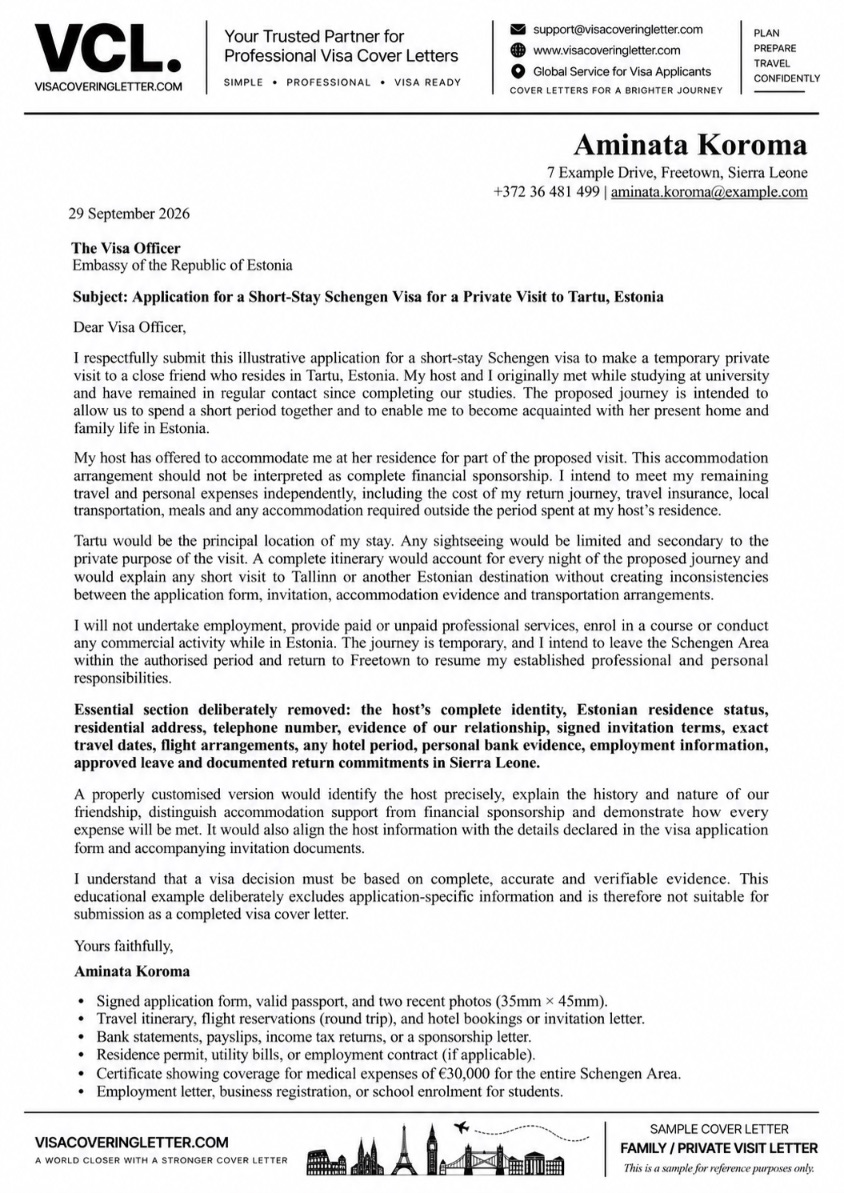
Type Three: Estonia Family or Friend Visit Visa Cover Letter
An Estonia visit visa cover letter is appropriate when the principal reason is spending a temporary period with a relative or friend. It should explain the relationship, host’s lawful circumstances, address, visit duration and financial division. Hosting and sponsorship are separate concepts: offering accommodation does not necessarily mean paying for flights or daily expenses.
The Sierra Leonean visitor in this illustration plans to stay with a former university classmate in Tartu. The relationship has a history, but a real file would need the relevant invitation and host documentation required by the applicable checklist.
Aminata Koroma
7 Example Drive, Freetown, Sierra Leone
+372 36 481 499 | aminata.koroma@example.com
29 September 2026
The Visa Officer
Embassy of the Republic of Estonia
Subject: Application for a Short-Stay Schengen Visa for a Private Visit to Tartu, Estonia
Dear Visa Officer,
I respectfully submit this illustrative application for a short-stay Schengen visa to make a temporary private visit to a close friend who resides in Tartu, Estonia. My host and I originally met while studying at university and have remained in regular contact since completing our studies. The proposed journey is intended to allow us to spend a short period together and to enable me to become acquainted with her present home and family life in Estonia.
My host has offered to accommodate me at her residence for part of the proposed visit. This accommodation arrangement should not be interpreted as complete financial sponsorship. I intend to meet my remaining travel and personal expenses independently, including the cost of my return journey, travel insurance, local transportation, meals and any accommodation required outside the period spent at my host’s residence.
Tartu would be the principal location of my stay. Any sightseeing would be limited and secondary to the private purpose of the visit. A complete itinerary would account for every night of the proposed journey and would explain any short visit to Tallinn or another Estonian destination without creating inconsistencies between the application form, invitation, accommodation evidence and transportation arrangements.
I will not undertake employment, provide paid or unpaid professional services, enrol in a course or conduct any commercial activity while in Estonia. The journey is temporary, and I intend to leave the Schengen Area within the authorised period and return to Freetown to resume my established professional and personal responsibilities.
Essential section deliberately removed: the host’s complete identity, Estonian residence status, residential address, telephone number, evidence of our relationship, signed invitation terms, exact travel dates, flight arrangements, any hotel period, personal bank evidence, employment information, approved leave and documented return commitments in Sierra Leone.
A properly customised version would identify the host precisely, explain the history and nature of our friendship, distinguish accommodation support from financial sponsorship and demonstrate how every expense will be met. It would also align the host information with the details declared in the visa application form and accompanying invitation documents.
I understand that a visa decision must be based on complete, accurate and verifiable evidence. This educational example deliberately excludes application-specific information and is therefore not suitable for submission as a completed visa cover letter.
Yours faithfully,
Aminata Koroma
Type Four: Estonia Medical Visa Cover Letter
An Estonia medical visa cover letter accompanies a short journey whose principal purpose is consultation, examination or treatment with an Estonian healthcare provider. The letter should follow the provider’s terminology, identify the planned care period, explain payment and account for accommodation and any companion. It should not exaggerate a wellness booking into clinical necessity.
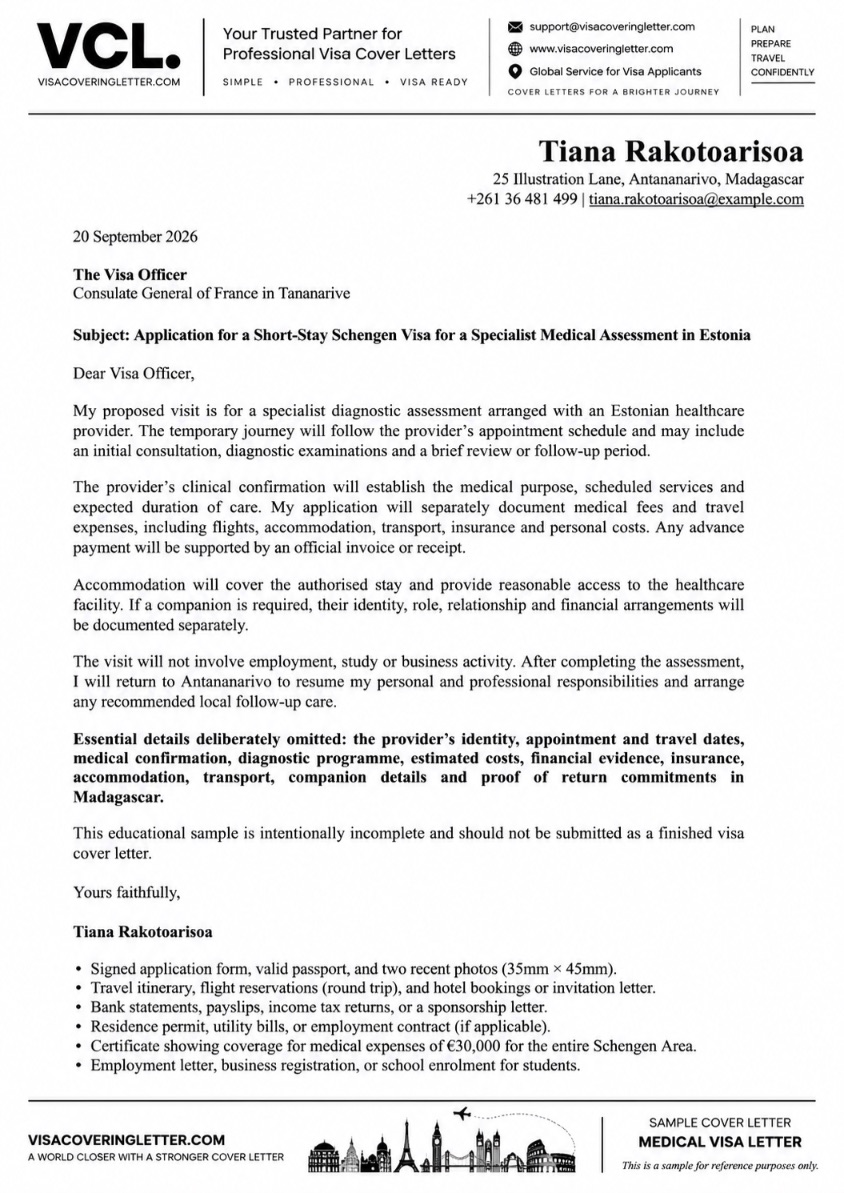
The fictional applicant from Madagascar seeks a specialist diagnostic review. The example limits personal medical detail and shows where provider-supported information belongs, while omitting everything required for a usable letter.
Tiana Rakotoarisoa
25 Illustration Lane, Antananarivo, Madagascar
+261 36 481 499 | tiana.rakotoarisoa@example.com
20 September 2026
The Visa Officer
Consulate General of France in Tananarive
Subject: Application for a Short-Stay Schengen Visa for a Specialist Medical Assessment in Estonia
Dear Visa Officer,
My proposed visit is for a specialist diagnostic assessment arranged with an Estonian healthcare provider. The temporary journey will follow the provider’s appointment schedule and may include an initial consultation, diagnostic examinations and a brief review or follow-up period.
The provider’s clinical confirmation will establish the medical purpose, scheduled services and expected duration of care. My application will separately document medical fees and travel expenses, including flights, accommodation, transport, insurance and personal costs. Any advance payment will be supported by an official invoice or receipt.
Accommodation will cover the authorised stay and provide reasonable access to the healthcare facility. If a companion is required, their identity, role, relationship and financial arrangements will be documented separately.
The visit will not involve employment, study or business activity. After completing the assessment, I will return to Antananarivo to resume my personal and professional responsibilities and arrange any recommended local follow-up care.
Essential details deliberately omitted: the provider’s identity, appointment and travel dates, medical confirmation, diagnostic programme, estimated costs, financial evidence, insurance, accommodation, transport, companion details and proof of return commitments in Madagascar.
This educational sample is intentionally incomplete and should not be submitted as a finished visa cover letter.
Yours faithfully,
Tiana Rakotoarisoa
Type Five: Estonia Cultural, Sports or Short-Study Visa Cover Letter
This category covers several distinct short activities, including a cultural programme, sports event or qualifying course. The cover letter for Estonian visa purposes must name the real activity rather than combine all three labels. It should explain the applicant’s role, organiser, programme dates, funding, accommodation and connection to continuing commitments. A programme exceeding the short-stay framework may require a national visa or residence route.
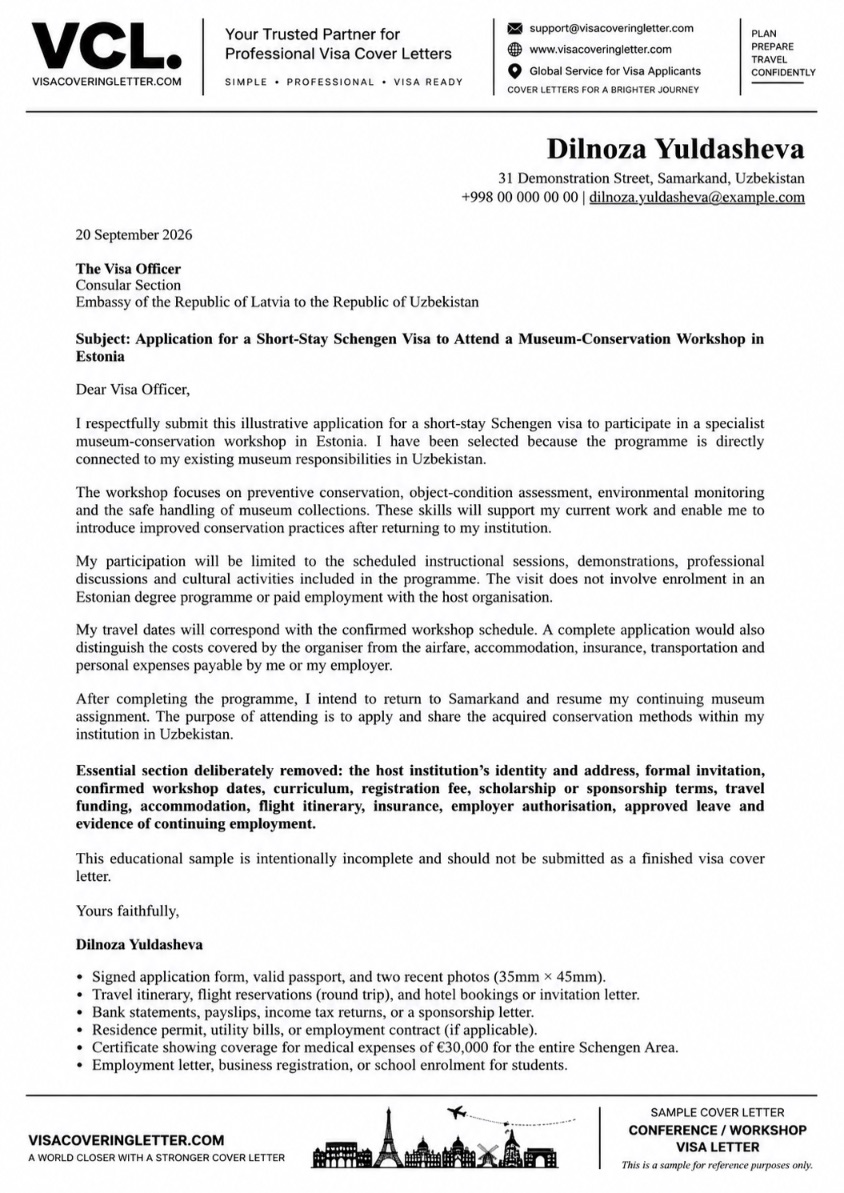
The illustration below uses a short cultural workshop for an Uzbek museum conservator. The purpose is professional-cultural participation, not local employment or admission to a long degree.
Dilnoza Yuldasheva
31 Demonstration Street, Samarkand, Uzbekistan
+998 00 000 00 00 | dilnoza.yuldasheva@example.com
20 September 2026
The Visa Officer
Consular Section
Embassy of the Republic of Latvia to the Republic of Uzbekistan
Subject: Application for a Short-Stay Schengen Visa to Attend a Museum-Conservation Workshop in Estonia
Dear Visa Officer,
I respectfully submit this illustrative application for a short-stay Schengen visa to participate in a specialist museum-conservation workshop in Estonia. I have been selected because the programme is directly connected to my existing museum responsibilities in Uzbekistan.
The workshop focuses on preventive conservation, object-condition assessment, environmental monitoring and the safe handling of museum collections. These skills will support my current work and enable me to introduce improved conservation practices after returning to my institution.
My participation will be limited to the scheduled instructional sessions, demonstrations, professional discussions and cultural activities included in the programme. The visit does not involve enrolment in an Estonian degree programme or paid employment with the host organisation.
My travel dates will correspond with the confirmed workshop schedule. A complete application would also distinguish the costs covered by the organiser from the airfare, accommodation, insurance, transportation and personal expenses payable by me or my employer.
After completing the programme, I intend to return to Samarkand and resume my continuing museum assignment. The purpose of attending is to apply and share the acquired conservation methods within my institution in Uzbekistan.
Essential section deliberately removed: the host institution’s identity and address, formal invitation, confirmed workshop dates, curriculum, registration fee, scholarship or sponsorship terms, travel funding, accommodation, flight itinerary, insurance, employer authorisation, approved leave and evidence of continuing employment.
This educational sample is intentionally incomplete and should not be submitted as a finished visa cover letter.
Yours faithfully,
Dilnoza Yuldasheva
Type Six: Estonia Employment Work Visa Cover Letter
An Estonia work visa cover letter is not a job-application letter sent to an employer. It is a supporting explanation for the appropriate immigration application after a genuine employment arrangement exists. Depending on the circumstances, an applicant may need a long-stay D visa connected with registered short-term employment or a residence-permit route. The letter should accurately identify the procedure, employer, position, permission or registration, intended residence and financial arrangements.
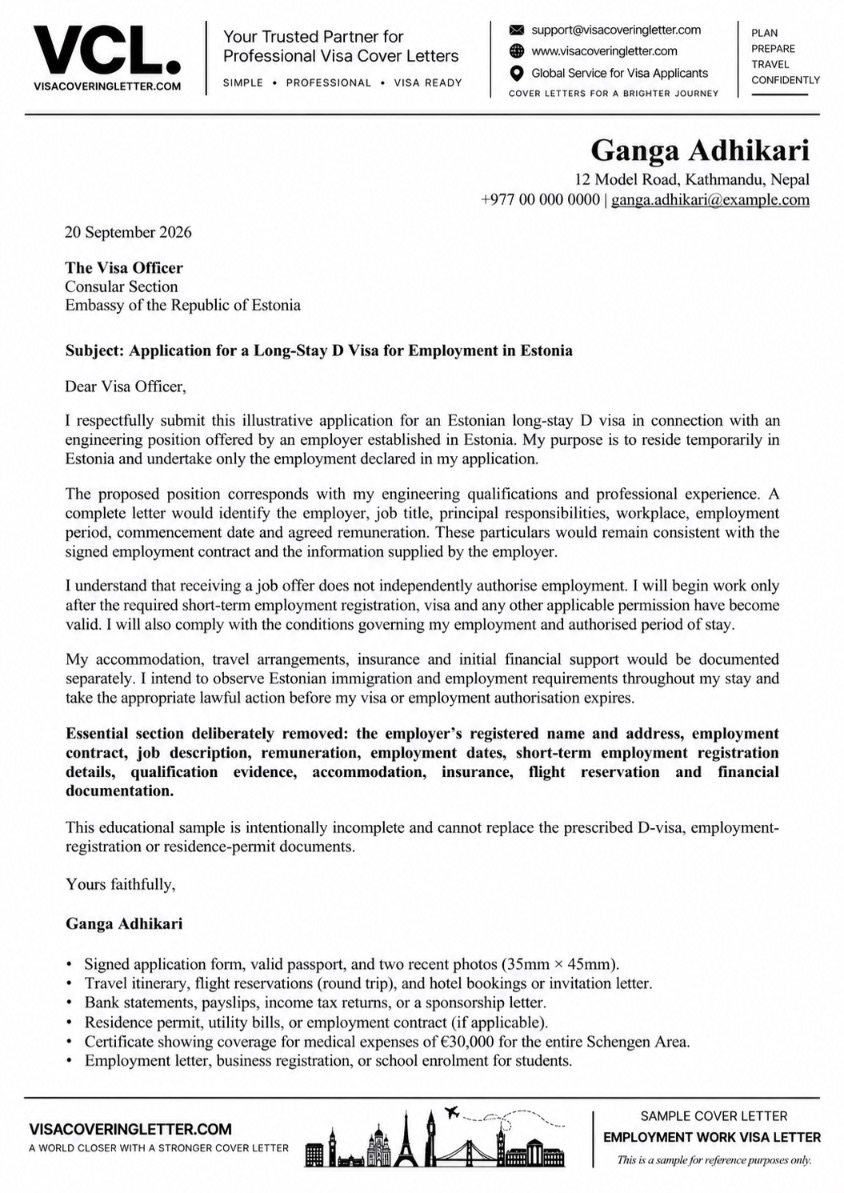
The Nepalese engineer below illustrates a long-stay D-visa context involving proposed short-term employment. A real application must be built around current official requirements and the employer’s completed steps. The excerpt deliberately omits every operational detail that could make it appear submission-ready.
Ganga Adhikari
12 Model Road, Kathmandu, Nepal
+977 00 000 0000 | ganga.adhikari@example.com
20 September 2026
The Visa Officer
Consular Section
Embassy of the Republic of Estonia
Subject: Application for a Long-Stay D Visa for Employment in Estonia
Dear Visa Officer,
I respectfully submit this illustrative application for an Estonian long-stay D visa in connection with an engineering position offered by an employer established in Estonia. My purpose is to reside temporarily in Estonia and undertake only the employment declared in my application.
The proposed position corresponds with my engineering qualifications and professional experience. A complete letter would identify the employer, job title, principal responsibilities, workplace, employment period, commencement date and agreed remuneration. These particulars would remain consistent with the signed employment contract and the information supplied by the employer.
I understand that receiving a job offer does not independently authorise employment. I will begin work only after the required short-term employment registration, visa and any other applicable permission have become valid. I will also comply with the conditions governing my employment and authorised period of stay.
My accommodation, travel arrangements, insurance and initial financial support would be documented separately. I intend to observe Estonian immigration and employment requirements throughout my stay and take the appropriate lawful action before my visa or employment authorisation expires.
Essential section deliberately removed: the employer’s registered name and address, employment contract, job description, remuneration, employment dates, short-term employment registration details, qualification evidence, accommodation, insurance, flight reservation and financial documentation.
This educational sample is intentionally incomplete and cannot replace the prescribed D-visa, employment-registration or residence-permit documents.
Yours faithfully,
Ganga Adhikari
Frequently Asked Questions About Estonia Visa Cover Letters
Is a cover letter mandatory for every Estonia visa application?
Not necessarily. Requirements depend on the visa purpose, filing location, locally harmonised checklist and any request from the responsible authority. A cover letter can still be valuable when it explains a multi-country route, mixed funding, private accommodation or another point not obvious from standard documents. Check the current instructions for the applicant’s country of lawful residence rather than assuming one global list applies everywhere.
What should the first paragraph of an Estonia visa cover letter say?
It should normally identify the applicant, requested visa category, principal purpose and proposed travel period. If the application depends on an invitation, course, event or treatment, name that central reason concisely. Avoid beginning with a long account of why Estonia is beautiful.
How long should the letter be?
There is no universal official word count. A straightforward short-stay application may fit comfortably into one page, while a case needing genuine clarification may require a second. Remove repetition before reducing necessary explanation. The reader should be able to find purpose, route, accommodation, funding and return circumstances quickly.
Can I use one of the free samples above?
No. They are deliberately incomplete editorial fragments with fictional identities, invalid email domains and missing critical information. They illustrate the difference between visa purposes but are not templates for submission. A real letter must be written around the applicant’s evidence and the correct receiving authority.
Should I call it an Estonia cover letter, application letter or letter of explanation?
All three expressions can describe a supporting document, although local instructions may use particular terminology. The heading is less important than the document’s function. It should accurately explain the application and remain distinct from an invitation, employer letter or motivation statement.
Is Tallinn required to appear in every tourist letter?
No. Mention the destinations the applicant will actually visit. A journey focused on Tartu, Pärnu, Narva, Saaremaa or another location should not insert Tallinn merely because it is the capital. If Tallinn is only the arrival point, describe it at that scale.
What if I enter through Helsinki but spend most of the trip in Estonia?
Explain the full route, including whether Helsinki is a same-day connection, day visit or overnight destination. Entry through Finland does not automatically make Finland the competent state if Estonia is genuinely the sole or main destination. The transport and accommodation records must support the explanation.
Can my friend in Estonia sponsor the visit?
Support can take different forms. The friend may provide accommodation, pay specified expenses or offer broader documented sponsorship where the applicable rules allow it. State the exact arrangement and follow the current checklist for host and financial evidence. Do not use “sponsor” as a substitute for explaining who pays each cost.
Should I include my full bank balance in the letter?
Usually the letter can identify the funding source and refer to the supporting statements without reproducing sensitive transaction history. If an amount is material to the explanation, label the currency clearly and ensure the evidence supports it. The official subsistence benchmark should be checked on the submission date, but meeting a numerical threshold alone does not guarantee approval.
Do I need to buy a non-refundable flight before applying?
Follow the travel-evidence instructions applicable to the application. A cover letter should describe the document actually held: reservation, booking or paid ticket. Purchasing a costly non-refundable ticket does not ensure a visa decision, and the letter should never imply that it does.
Can a business visitor add tourism days?
Yes, when the itinerary and permission allow it and the principal purpose remains accurately stated. Explain the business schedule first, then account for the limited leisure extension, accommodation and expenses. Do not allow the tourism paragraph to obscure the invitation or change the filing logic.
Is an Estonia work visa cover letter the same as a CV cover letter?
No. A recruitment cover letter persuades an employer to consider a candidate. A visa supporting letter explains an existing immigration purpose and connects it with employment records, registration or authorisation, accommodation, insurance and other prescribed documents. It must name the actual visa or residence route rather than ask for a job.
Can I submit the same letter after my bookings change?
Only if every statement remains accurate, which is uncommon when dates, hotels or routes change materially. Update the letter, application form and any connected records so the submitted file describes one current plan. Follow the authority’s process if a material change occurs after submission.
Should a previous refusal be mentioned?
Answer every application question truthfully. If the earlier decision is relevant or the new application relies on changed evidence, a concise explanation can help. Identify the real change rather than criticising the previous authority or merely rewriting the same unsupported claim.
Does a professional cover letter improve approval chances?
A professional document can improve clarity, organisation and consistency. It cannot change the legal requirements, compensate for false information or guarantee approval. Its practical value is making the genuine application easier to understand and reducing avoidable presentation errors.
Can one letter cover a family travelling together?
Shared travel arrangements can be explained consistently, but each applicant has an individual identity, financial position and application. Minors and sponsored family members can require additional documents. Follow the local filing instructions and do not assume one adult’s employment or bank record automatically establishes every traveller’s circumstances.
In which language should the Estonia visa letter be written?
Follow the receiving authority’s current language and translation instructions. An English cover letter may be accepted in many contexts, but that does not automatically mean every civil, financial or employment document can remain untranslated. Long-stay applications can have specific legalisation, apostille and translation requirements.
Final Pre-Submission Audit
Before signing, read the letter once as a reviewer and once as the applicant. The reviewer’s reading asks whether the purpose, jurisdiction, route, money and evidence are understandable. The applicant’s reading asks whether every sentence is true and whether any arrangement has changed.
Use this final audit:
- the full name and passport details match the application;
- the correct visa category and real principal purpose are stated;
- the recipient and address have been verified for the filing location;
- Estonia is defensibly the sole or main destination;
- arrival, internal movement and departure dates agree across the file;
- every overnight stay is covered without unexplained gaps or overlaps;
- host, employer, institution and provider names match their documents;
- the funding division is accurate and supported;
- temporary return circumstances are specific and truthful where relevant;
- any material irregularity receives a concise evidence-based explanation;
- the attachment list contains only current submitted documents;
- provisional reservations are not described as paid or confirmed when they are not;
- the letter contains no leftover names, pronouns, countries or facts from a sample;
- the applicant has reviewed the editable final version before submission.
Conclusion: Make the Estonia Application Read as One Coherent Case
The strongest cover letter for Estonia visa purposes is not the one with the grandest language. It is the one whose statements survive comparison with the rest of the file. The purpose matches the invitation or booking. Estonia’s responsibility is clear. The dates form a possible journey. Accommodation covers the stay. Funding is divided honestly. The applicant’s continuing circumstances are described without exaggeration. Any unusual point is explained with evidence rather than hidden under generic wording.
Tourism, business, family visits, medical care, cultural or short-study programmes and employment each require a different centre of gravity. That is why public samples can demonstrate tone but should not be converted into finished applications. The decisive facts are personal, and the language should be built around them.
VCL. offers a faster route to a professionally organised, personalized letter in editable Word and PDF formats, delivered by email and prepared around the information supplied. The applicant should still verify every detail and follow the current instructions of the competent authority. A cover letter supports a truthful application; it does not replace evidence or control the decision.
When the narrative and the documents tell the same story, the application becomes easier to review, easier to verify and less vulnerable to avoidable confusion. That is the practical standard worth aiming for.