A business visa application is judged very differently from a tourist or study visa. The focus is not on sightseeing or academics, but on professional intent, commercial clarity, and short-term compliance. At the center of this evaluation sits one critical document: the cover letter for business visa.
This letter explains why you are traveling for business, who you will meet, how long you will stay, who is paying for the trip, and why you will return. Without a clear explanation, even strong documents such as invitation letters or conference registrations can feel incomplete to a visa officer.
This guide shows you how to write a business visa cover letter that explains meetings, events, and sponsorship clearly without sounding vague, promotional, or risky.
Key takeaways.
A strong business visa cover letter must clearly state the purpose of travel, identify the host company, explain the agenda and duration, and clarify who is paying for the trip.
The letter should be factual, professional, and short (one page). It should support not repeat your invitation letter and employer documents.
What is a cover letter for business visa?
A cover letter for business visa is a formal letter addressed to the embassy or consulate explaining the professional reason for your travel. It acts as a summary and context document for supporting papers such as:
- Invitation letters
- Conference or trade fair registrations
- Employer letters
- Travel itinerary and expense details
Unlike tourist visa letters, business visa cover letters must be precise and verifiable. Visa officers are trained to assess whether a business visit is legitimate, time-bound, and non-immigrant in nature.
Why business visa cover letters are scrutinized more closely.
Business travel carries higher risk from an immigration perspective. Officers want to ensure that:
- The visit is genuinely short-term
- The applicant will not work illegally
- Expenses and sponsorship are transparent
- The applicant has strong ties to their home country
Your cover letter is where all these points are explained in one place. A weak or unclear explanation often leads to delays or additional document requests.
What a business visa cover letter must clearly explain.
A business visa cover letter should read like a professional briefing, not a personal essay. It should explain:
- The host company and relationship
- The exact purpose of the visit
- The agenda or activities
- The duration of stay
- Who will pay for expenses
- Your employer details
- Your intent to return
Each of these should be supported by documents but first introduced clearly in the letter.
Step-by-Step: how to write a cover letter for business visa.
Step 1: Professional Header and Embassy Details
Start with your full name, address, email, phone number, and passport number. Below that, write the embassy or consulate details and the date.
This immediately signals formality and seriousness.
Step 2: Clear Subject Line
Your subject line should state the purpose without ambiguity.
Example:
Subject: Application for Business Visa – Business Meetings with Host Company
Avoid vague phrases like “Visa Request” or “Business Travel.”
Step 3: Introduction and Applicant Identity
In the opening paragraph, state:
- Your name and nationality
- Your employer or business role
- That you are applying for a business visa
This paragraph sets context and should be concise.
Step 4: Explain the Business Purpose and Agenda
This is the most important section.
Clearly explain:
- Why you are traveling
- What activities you will engage in (meetings, negotiations, conference, trade fair)
- That no employment or paid work will be performed
If there is an invitation letter, this section should match it exactly.
Step 5: Mention Host Company and Relationship
Identify:
- Host company name
- Location
- Nature of professional relationship
This helps the visa officer understand the legitimacy of the visit.
Step 6: Clarify Duration and Travel Itinerary
State:
- Entry and exit dates
- Cities you will visit
- Duration of meetings or events
This should align with your flight and hotel documents.
Step 7: Explain Funding (Company-Paid vs Self-Paid)
This section is often misunderstood, but extremely important.
You must clearly state:
- Who is paying for travel, accommodation, and daily expenses
- Whether expenses are covered by your employer, host company, or yourself
Supporting documents must match this explanation.
Step 8: Confirm Compliance and Return Intent
End by confirming:
- You will comply with visa conditions
- You will not overstay or work illegally
- You will return to your home country after the visit
This reassurance is essential for approval.
Company-paid vs self-paid business travel (how to explain it).
When the company pays, your letter should clearly state that expenses are covered and reference the employer or sponsor letter.
When self-paid, explain that you will cover all costs personally and provide proof of funds.
Mixed funding (e.g., employer pays flights, applicant pays accommodation) should be explained transparently. Ambiguity here is a common reason for visa delays.
Cover letter for business visa template:
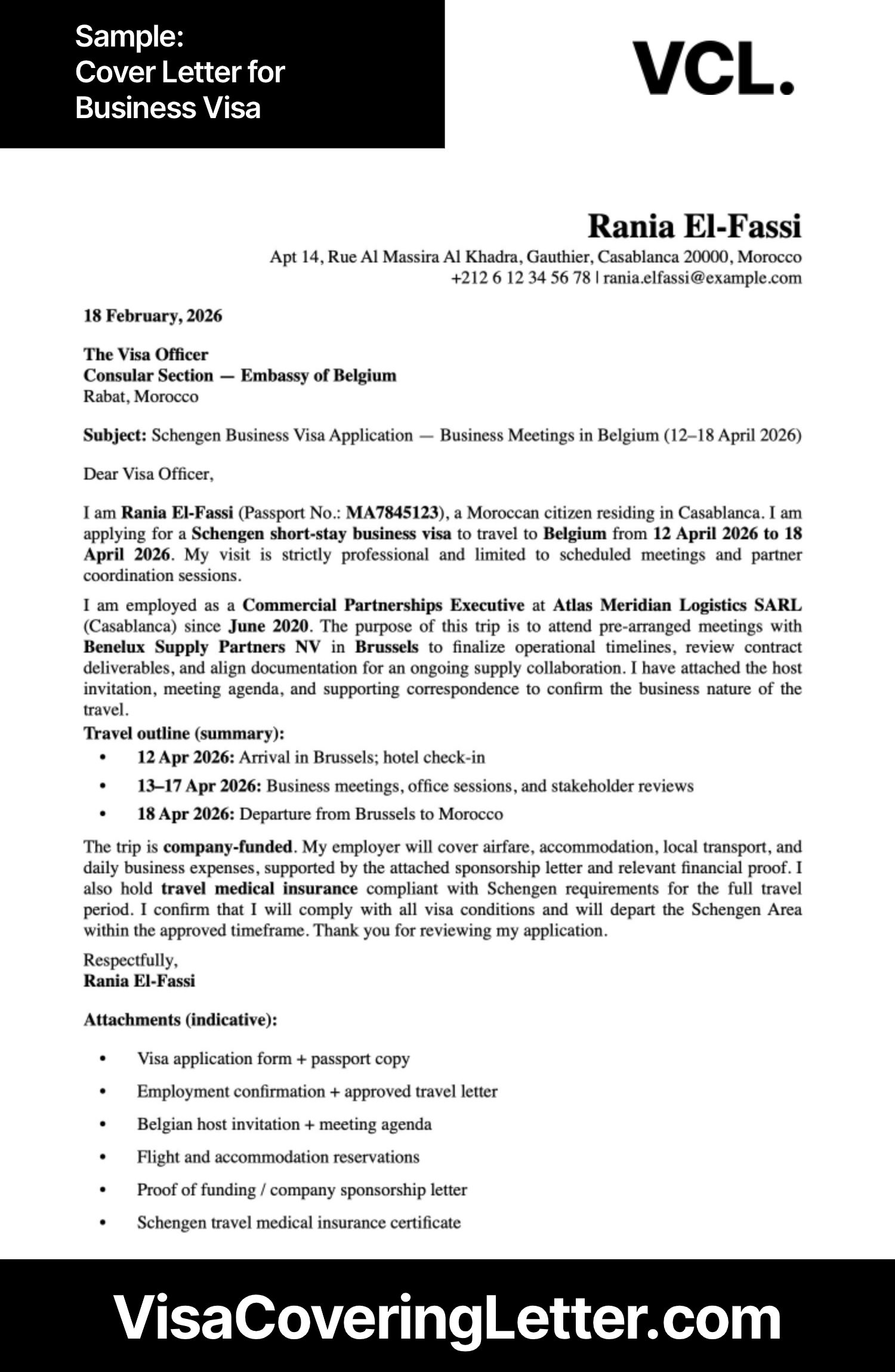
Rania El-Fassi
Apt 14, Rue Al Massira Al Khadra, Gauthier, Casablanca 20000, Morocco
+212 6 12 34 56 78 | rania.elfassi@example.com
18 February, 2026
The Visa Officer
Consular Section — Embassy of Belgium
Rabat, Morocco
Subject: Schengen Business Visa Application — Business Meetings in Belgium (12–18 April 2026) Dear Visa Officer,
I am Rania El-Fassi (Passport No.: MA7845123), a Moroccan citizen residing in Casablanca. I am applying for a Schengen short-stay business visa to travel to Belgium from 12 April 2026 to 18 April 2026. My visit is strictly professional and limited to scheduled meetings and partner coordination sessions.
I am employed as a Commercial Partnerships Executive at Atlas Meridian Logistics SARL (Casablanca) since June 2020. The purpose of this trip is to attend pre-arranged meetings with Benelux Supply Partners NV in Brussels to finalize operational timelines, review contract deliverables, and align documentation for an ongoing supply collaboration. I have attached the host invitation, meeting agenda, and supporting correspondence to confirm the business nature of the travel.
Travel outline (summary):
- 12 Apr 2026: Arrival in Brussels; hotel check-in
- 13–17 Apr 2026: Business meetings, office sessions, and stakeholder reviews • 18 Apr 2026: Departure from Brussels to Morocco
The trip is company-funded. My employer will cover airfare, accommodation, local transport, and daily business expenses, supported by the attached sponsorship letter and relevant financial proof. I also hold travel medical insurance compliant with Schengen requirements for the full travel period. I confirm that I will comply with all visa conditions and will depart the Schengen Area within the approved timeframe. Thank you for reviewing my application.
Respectfully,
Rania El-Fassi
Attachments (indicative):
- Visa application form + passport copy
- Employment confirmation + approved travel letter
- Belgian host invitation + meeting agenda
- Flight and accommodation reservations
- Proof of funding / company sponsorship letter
- Schengen travel medical insurance certificate
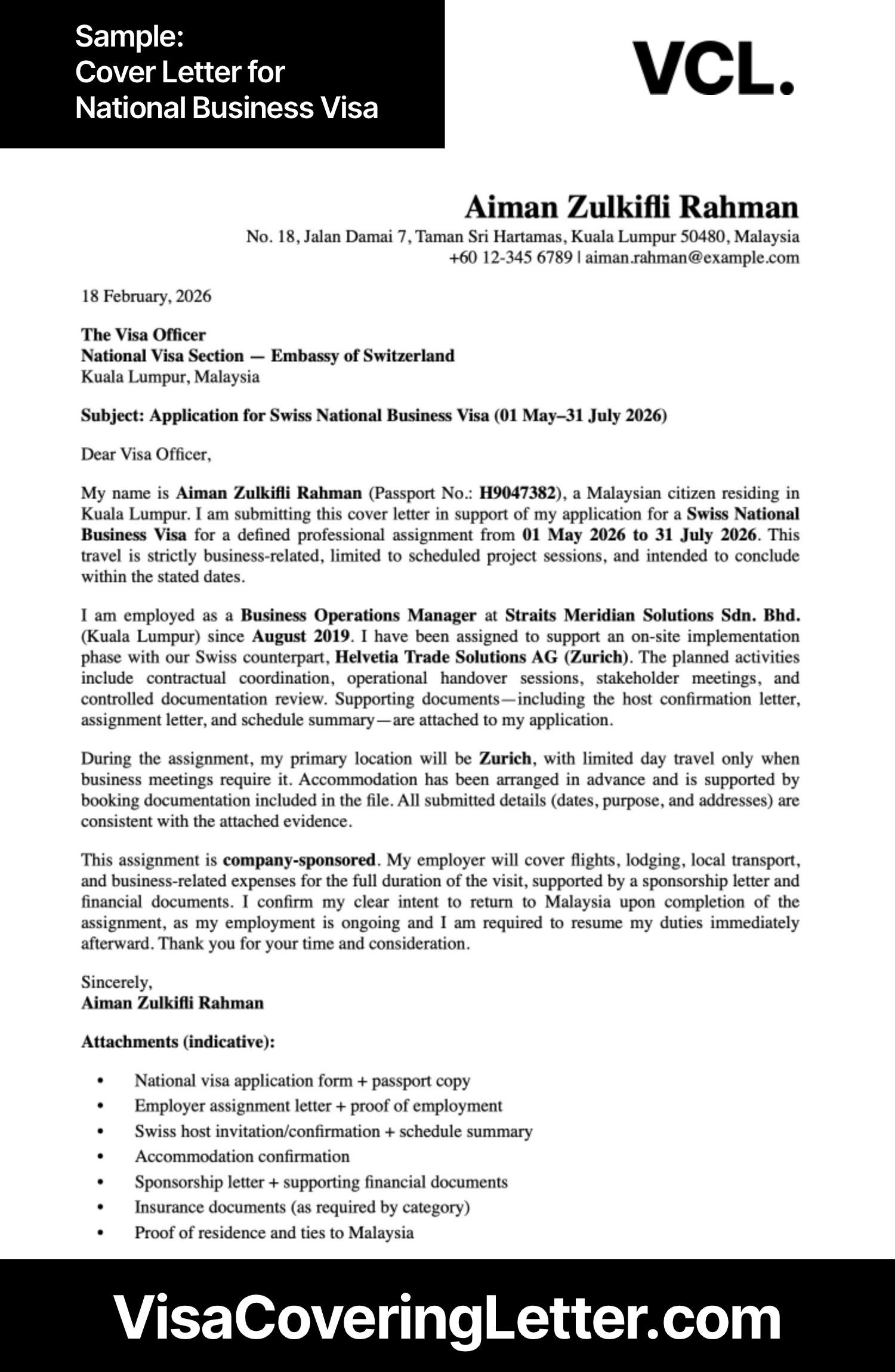
Cover letter template for national (long-stay) business visa:
Aiman Zulkifli Rahman
No. 18, Jalan Damai 7, Taman Sri Hartamas, Kuala Lumpur 50480, Malaysia +60 12-345 6789 | aiman.rahman@example.com
18 February, 2026
The Visa Officer
National Visa Section — Embassy of Switzerland
Kuala Lumpur, Malaysia
Subject: Application for Swiss National Business Visa (01 May–31 July 2026) Dear Visa Officer,
My name is Aiman Zulkifli Rahman (Passport No.: H9047382), a Malaysian citizen residing in Kuala Lumpur. I am submitting this cover letter in support of my application for a Swiss National Business Visa for a defined professional assignment from 01 May 2026 to 31 July 2026. This travel is strictly business-related, limited to scheduled project sessions, and intended to conclude within the stated dates.
I am employed as a Business Operations Manager at Straits Meridian Solutions Sdn. Bhd. (Kuala Lumpur) since August 2019. I have been assigned to support an on-site implementation phase with our Swiss counterpart, Helvetia Trade Solutions AG (Zurich). The planned activities include contractual coordination, operational handover sessions, stakeholder meetings, and controlled documentation review. Supporting documents—including the host confirmation letter, assignment letter, and schedule summary—are attached to my application.
During the assignment, my primary location will be Zurich, with limited day travel only when business meetings require it. Accommodation has been arranged in advance and is supported by booking documentation included in the file. All submitted details (dates, purpose, and addresses) are consistent with the attached evidence.
This assignment is company-sponsored. My employer will cover flights, lodging, local transport, and business-related expenses for the full duration of the visit, supported by a sponsorship letter and financial documents. I confirm my clear intent to return to Malaysia upon completion of the assignment, as my employment is ongoing and I am required to resume my duties immediately afterward. Thank you for your time and consideration.
Sincerely,
Aiman Zulkifli Rahman
Attachments (indicative):
- National visa application form + passport copy
- Employer assignment letter + proof of employment
- Swiss host invitation/confirmation + schedule summary
- Accommodation confirmation
- Sponsorship letter + supporting financial documents
- Insurance documents (as required by category)
- Proof of residence and ties to Malaysia
Why this cover letter works.
This example works because it:
- Clearly defines the business purpose
- Matches the invitation letter
- Explains funding transparently
- Confirms short-term intent and return
Visa officers can quickly assess legitimacy without searching through multiple documents.
Common mistakes and how to fix them.
One common mistake is writing too vaguely about the purpose of travel. Phrases like “business discussions” without details raise red flags. Always specify meetings, conferences, or events.
Another issue is unclear funding. If the cover letter does not clearly explain who pays, officers may assume insufficient funds.
Applicants also sometimes imply work activity unintentionally. Avoid words that suggest employment, training, or operational work unless explicitly permitted.
Finally, inconsistencies between the cover letter and invitation letter can lead to rejection. Always cross-check dates, company names, and roles.

Frequently asked questions.
Is a cover letter mandatory for a business visa?
In most cases, yes. It is a core document that explains the professional purpose of travel.
How long should a business visa cover letter be?
One page is ideal, typically 300–400 words.
Should I attach the invitation letter separately?
Yes. The cover letter explains it; the invitation letter proves it.
Can a company write the cover letter instead of me?
No. The applicant writes the cover letter. The company provides a support or invitation letter.
Should I include salary details?
Only if required. Usually, employer confirmation is sufficient.
What if expenses are shared between host and employer?
Explain the split clearly and attach supporting letters.
Can I use the same cover letter for multiple countries?
No. Each embassy requires a country-specific explanation.
Is a conference visa different from a business visa?
Often it is a subcategory. The cover letter still follows the same principles.
Should I mention past business travel?
Only if relevant and positive. Do not overload the letter.
Conclusion.
A well-written cover letter for business visa turns a set of documents into a clear professional narrative. When meetings, agendas, and sponsorship are explained transparently, visa officers can assess your application efficiently and confidently.
Focus on clarity, consistency, and compliance—and let your business purpose speak for itself.