When you’re applying for an employment visa whether it’s to take up a job abroad, transfer within your company, or establish your own business the cover letter for employment visa plays a decisive role.
This single document bridges the gap between your paperwork and your purpose. It’s your personal statement to the consulate, showing that your professional journey, job offer, or entrepreneurial plan is credible and aligns with the destination country’s visa requirements.
While your employment contract, qualifications, and documents serve as evidence, your cover letter serves as context. It tells the visa officer who you are, why you’re going, and what value you’ll bring.
Let’s walk through how to craft an embassy-ready employment visa cover letter – structured, professional, and tailored to your work category.
Understanding the role of the employment visa cover letter.
Unlike a generic visa letter, an employment visa cover letter is not about tourism or personal travel — it’s about professional purpose.
The letter clarifies your employment terms, your sponsor or company, your role, and (if applicable) how your visit contributes to a broader business or national interest.
A clear and concise letter helps the embassy officer make sense of your intent and verify that your job aligns with the country’s work regulations.
In short, it answers three fundamental questions:
- Why are you traveling?
- Who is employing or sponsoring you?
- Are you a credible, compliant applicant?
Structuring the perfect employment visa cover letter.
Though the tone should be formal and factual, your letter doesn’t need to sound robotic. It should have a natural flow — professional, confident, and respectful.
A standard cover letter usually includes:
- Personal and contact information
- Embassy address and date
- Subject line (e.g., Application for Employment Visa – Skilled Worker Role)
- Introduction (who you are and what position you’ve been offered)
- Employment details (employer name, role, duration, and contract terms)
- Funding and accommodation information
- Declaration of compliance with visa conditions
- Signature and contact details
Writing style and tone.
This type of cover letter should read like a formal business correspondence, not a narrative essay. Avoid flowery language. Be concise and transparent. Use short paragraphs, professional greetings, and respectful closings.
A simple rule: write as if you’re explaining your employment to a government official who’s seeing your application for the first time.
Cover letter for employee (job offer or intra-company transfer).
For employees who have received a job offer from a foreign employer or are being transferred within their company, the cover letter should reflect both personal clarity and employer endorsement.
You should:
- Mention your full name, nationality, and job position.
- Reference your employer’s name, location, and contract duration.
- Confirm your salary or financial arrangements (optional).
- Emphasize your compliance with local work visa rules.
- State your intent to respect the terms of your employment.
Cover letter for skilled worker visa applicants.
Skilled workers (engineers, healthcare professionals, technicians, and other certified experts) often apply under government-recognized skill categories or points-based visa systems.
Your letter should emphasize:
- Your professional qualifications and certifications
- Relevance of your skills to the host country’s labor market
- Employer or sponsor details (if applicable)
- Intention to contribute long-term professionally
Cover letter for self-employed applicants.
Self-employed professionals entrepreneurs, consultants, or freelancers face a unique challenge: proving their business credibility and financial stability.
A strong self-employed visa cover letter should:
- Outline your business purpose or project
- Indicate client contracts or proof of freelance income
- Mention accommodation, financial capacity, and professional ties
- Clarify compliance with self-employment visa or residence laws
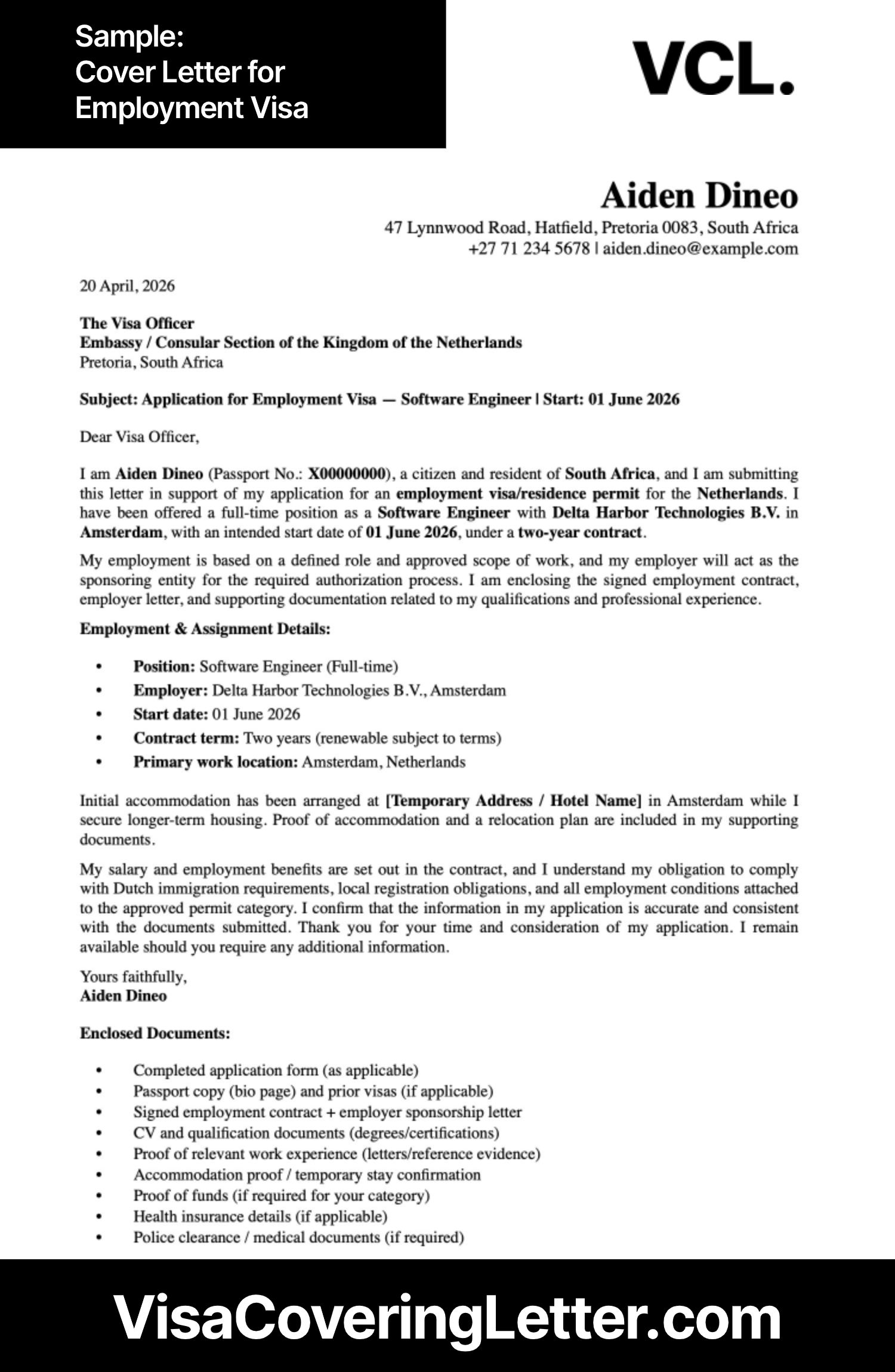
Cover letter for employment visa template:
Aiden Dineo
47 Lynnwood Road, Hatfield, Pretoria 0083, South Africa
+27 71 234 5678 | aiden.dineo@example.com
20 April, 2026
The Visa Officer
Embassy / Consular Section of the Kingdom of the Netherlands
Pretoria, South Africa
Subject: Application for Employment Visa — Software Engineer | Start: 01 June 2026 Dear Visa Officer,
I am Aiden Dineo (Passport No.: X00000000), a citizen and resident of South Africa, and I am submitting this letter in support of my application for an employment visa/residence permit for the Netherlands. I have been offered a full-time position as a Software Engineer with Delta Harbor Technologies B.V. in Amsterdam, with an intended start date of 01 June 2026, under a two-year contract.
My employment is based on a defined role and approved scope of work, and my employer will act as the sponsoring entity for the required authorization process. I am enclosing the signed employment contract, employer letter, and supporting documentation related to my qualifications and professional experience.
Employment & Assignment Details:
- Position: Software Engineer (Full-time)
- Employer: Delta Harbor Technologies B.V., Amsterdam
- Start date: 01 June 2026
- Contract term: Two years (renewable subject to terms)
- Primary work location: Amsterdam, Netherlands
Initial accommodation has been arranged at [Temporary Address / Hotel Name] in Amsterdam while I secure longer-term housing. Proof of accommodation and a relocation plan are included in my supporting documents.
My salary and employment benefits are set out in the contract, and I understand my obligation to comply with Dutch immigration requirements, local registration obligations, and all employment conditions attached to the approved permit category. I confirm that the information in my application is accurate and consistent with the documents submitted. Thank you for your time and consideration of my application. I remain available should you require any additional information.
Yours faithfully,
Aiden Dineo
Enclosed Documents:
- Completed application form (as applicable)
- Passport copy (bio page) and prior visas (if applicable)
- Signed employment contract + employer sponsorship letter
- CV and qualification documents (degrees/certifications)
- Proof of relevant work experience (letters/reference evidence)
- Accommodation proof / temporary stay confirmation
- Proof of funds (if required for your category)
- Health insurance details (if applicable)
- Police clearance / medical documents (if required)
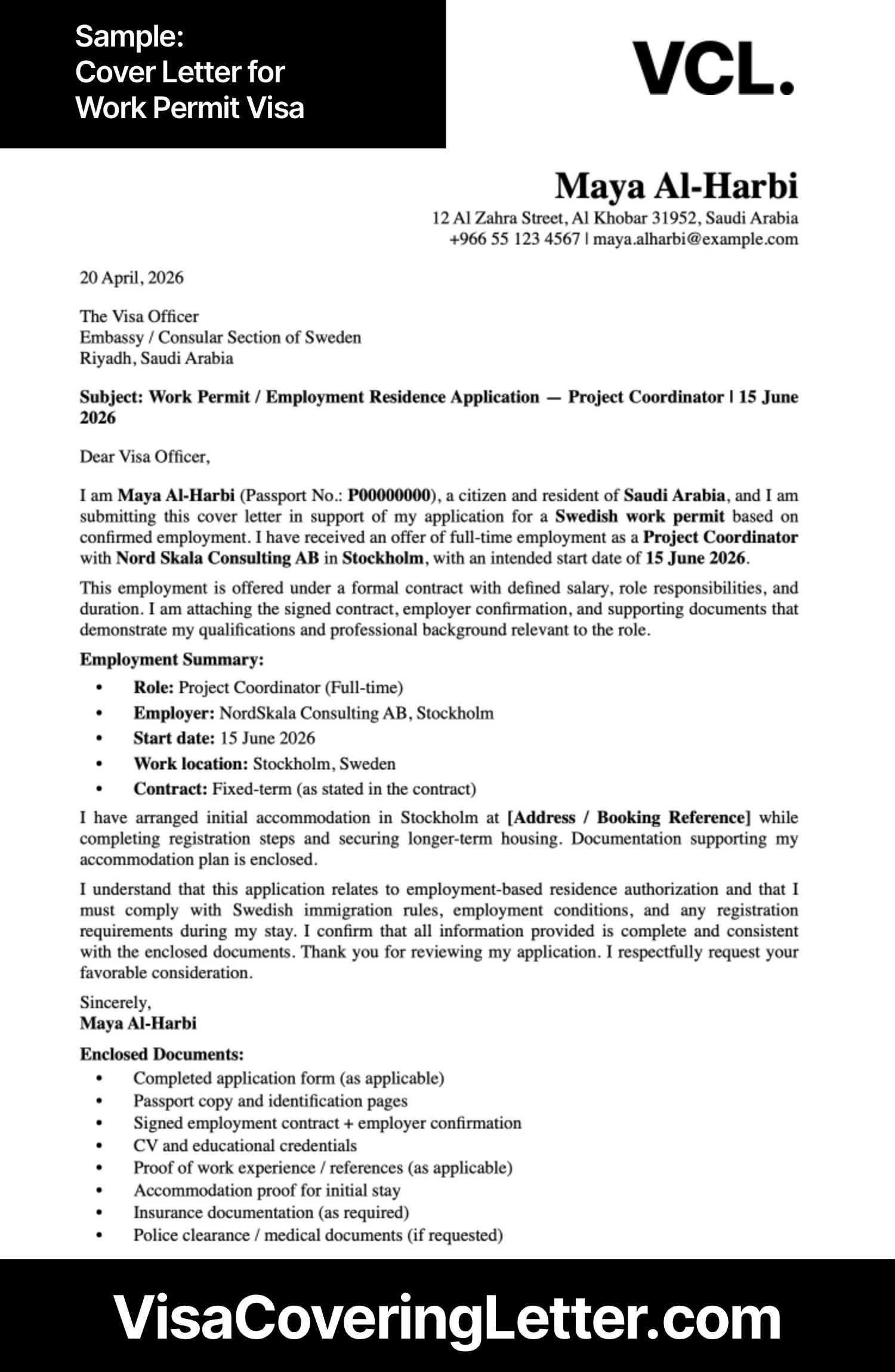
Cover letter sample for work visa application:
Maya Al-Harbi
12 Al Zahra Street, Al Khobar 31952, Saudi Arabia
+966 55 123 4567 | maya.alharbi@example.com
20 April, 2026
The Visa Officer
Embassy / Consular Section of Sweden
Riyadh, Saudi Arabia
Subject: Work Permit / Employment Residence Application — Project Coordinator | 15 June 2026
Dear Visa Officer,
I am Maya Al-Harbi (Passport No.: P00000000), a citizen and resident of Saudi Arabia, and I am submitting this cover letter in support of my application for a Swedish work permit based on confirmed employment. I have received an offer of full-time employment as a Project Coordinator with Nord Skala Consulting AB in Stockholm, with an intended start date of 15 June 2026.
This employment is offered under a formal contract with defined salary, role responsibilities, and duration. I am attaching the signed contract, employer confirmation, and supporting documents that demonstrate my qualifications and professional background relevant to the role.
Employment Summary:
- Role: Project Coordinator (Full-time)
- Employer: NordSkala Consulting AB, Stockholm
- Start date: 15 June 2026
- Work location: Stockholm, Sweden
- Contract: Fixed-term (as stated in the contract)
I have arranged initial accommodation in Stockholm at [Address / Booking Reference] while completing registration steps and securing longer-term housing. Documentation supporting my accommodation plan is enclosed.
I understand that this application relates to employment-based residence authorization and that I must comply with Swedish immigration rules, employment conditions, and any registration requirements during my stay. I confirm that all information provided is complete and consistent with the enclosed documents. Thank you for reviewing my application. I respectfully request your favorable consideration.
Sincerely,
Maya Al-Harbi
Enclosed Documents:
- Completed application form (as applicable)
- Passport copy and identification pages
- Signed employment contract + employer confirmation
- CV and educational credentials
- Proof of work experience / references (as applicable)
- Accommodation proof for initial stay
- Insurance documentation (as required)
- Police clearance / medical documents (if requested)
Aligning your letter with embassy documentation.
Your cover letter for employment visa must perfectly align with your other application materials.
If your letter mentions a start date or salary, it should match the employment contract. If your job title appears differently in your resume or permit form, update it for consistency.
This attention to detail builds trust and prevents unnecessary administrative delays.

Common mistakes to avoid.
Applicants often underestimate how closely embassies read their letters. Avoid:
- Over explaining personal details — focus on employment purpose.
- Mentioning unrelated travel history.
- Using inconsistent job titles across forms.
- Forgetting to reference attached documents.
- Writing in an overly casual or emotional tone.
The goal is to appear confident and compliant, not desperate or unprepared.
Tips from Visa Experts
- Use clear structure — officers appreciate order and clarity.
- Keep it professional — think of it as a letter to your future employer and the government.
- Ensure grammatical accuracy — simple, error-free writing is better than complex phrasing.
- Include contact details of your employer — this adds authenticity.
- Avoid mentioning salary unless required; focus on legitimacy, not luxury.
Frequently asked questions.
Is the cover letter mandatory for all work visa applications?
Not always, but most embassies require it as part of the professional documentation package.
How long should the cover letter be?
Keep it to one page — approximately 300–400 words.
Should my employer write a letter too?
Yes. The employer should issue an employment support letter confirming your job offer and sponsorship. Your letter complements theirs.
Can self-employed individuals apply without a contract?
Only if you can show other proofs, such as a business plan, client letters, or proof of income.
Do I need to notarize my letter?
No, but it must be signed and dated.
Can the same format be used for multiple countries?
You can adapt the structure, but the tone and requirements must match the specific embassy.
Should I attach my resume?
If the embassy requires it, yes — otherwise, your employment contract is sufficient.
What should I do if my job start date changes?
Update your letter and reprint it before submission to ensure accuracy.
Should I include salary details?
Only if required by the visa checklist; otherwise, summarize your financial arrangements generally.
Can my company HR prepare it for me?
They can assist, but the letter must be written and signed by the applicant.
Conclusion.
A cover letter for employment visa is your formal introduction to the embassy — a concise declaration of purpose and professionalism. Whether you’re an employee, skilled worker, or self-employed professional, the key lies in clarity, authenticity, and alignment with your documents.
Treat your cover letter as an extension of your career — precise, confident, and ready for opportunity.