A well-prepared immigration file is rarely rejected because one document is missing. More often, applications run into trouble because the story feels incomplete, inconsistent, or difficult to verify. That’s exactly why the cover letter for immigration visa application matters.
Unlike a tourist or short-stay case, immigration routes such as PR, settlement, or family migration ask the visa officer to evaluate your long-term intent, eligibility, and credibility. Your cover letter is where you make the officer’s job easier: you present your purpose, summarize your background, and map each claim to supporting evidence.
This guide explains how to write an immigration cover letter in a way that is clear, lawful-intent focused, and document-aligned without overpromising, oversharing, or accidentally weakening your case.
Quick takeaways
A strong immigration visa cover letter does not try to “sell” your case. It organizes it.
- Keep it factual and evidence-led (every key statement should be supported by a document)
- Use a clean visa application letter format with headings and a short attachment map
- Emphasize lawful intent, transparency, and documents consistency
- Explain any complex areas (sponsor evidence, timelines, name variations) simply
- Avoid claims you can’t prove, emotional language, or “guarantee” wording
- End with a short list of attachments and a polite request for consideration
Expert Note:
Industry research commonly shows that immigration officers look for consistency first. A concise cover letter helps them confirm that the case file reads like one coherent story.
What is a cover letter for immigration visa application?
A cover letter for immigration visa application is a formal, structured letter submitted with your immigration file. It introduces your application type (PR, settlement, family migration), summarizes the core facts, and points to the documents that support each part of your case.
You can think of it as a “navigation page” for your file:
- It outlines who you are and what you are applying for
- It provides a background summary relevant to eligibility
- It clarifies the timeline (relationship timeline, employment timeline, residence timeline)
- It explains how you meet requirements and where proof is located
This is especially valuable in immigration cases because the evidence set is larger and often includes sponsor documents, identity records, civil documents, financial records, and proof of relationship.
Why immigration cover letters need a different approach.
Short-stay cover letters often focus on itinerary and return. Immigration cover letters focus on:
- Lawful intent (you are applying through the proper route)
- Eligibility clarity (you meet the criteria of the category)
- Transparency (no conflicting statements, no hidden gaps)
- Timeline (a clear sequence of events that matches documents)
- Documents consistency (names, dates, addresses, relationships aligned)
A sloppy letter doesn’t automatically cause a refusal—but it can create doubts that lead to requests for additional evidence or longer processing times.
What to include in an immigration cover letter (document-aligned structure).
Here is a proven structure that works globally for an immigration, PR, or settlement file.
1) Header (Your Identifiers)
Include:
- Full legal name
- Address
- Email and phone
- Passport number (optional but helpful)
- Application reference number (if you have one)
2) Immigration Office/Embassy Address + Date
Use the correct receiving authority details where possible.
3) Subject Line (Clear, Specific)
Examples:
- “Subject: Application for Permanent Residence – [Category/Stream]”
- “Subject: Settlement Visa Application – Family Migration”
- “Subject: Sponsored Immigration Visa Application – [Relationship/Category]”
4) Purpose of Application
State what you are applying for and why you qualify, in simple terms.
5) Background Summary
Keep it focused:
- Work background if it supports eligibility
- Education background if it supports eligibility
- Relationship background if it supports family migration
Avoid unrelated life details.
6) Timeline
This is one of the strongest parts of an immigration cover letter. Immigration files often hinge on timelines:
- Relationship milestones
- Employment periods
- Residence history
- Sponsorship events
7) Evidence Map (Sponsor + Supporting Documents)
This is where your immigration document checklist cover letter becomes powerful: you connect claims to documents.
8) Closing (Lawful Intent + Transparency)
Confirm:
- All information is true and accurate
- You are providing documents transparently
- You will comply with legal requirements
Permanent residence vs settlement vs family migration: what changes in the letter.
Permanent Residence Cover Letter:
A permanent residence cover letter should emphasize:
- Eligibility under the chosen category
- Work/education credentials (as required)
- Proof of funds (if applicable)
- Any licensing or language evidence (if applicable)
Settlement Visa Cover Letter:
A settlement visa cover letter often needs:
- Clear lawful intent (settlement route, not temporary intent)
- Proof of relationship or sponsor eligibility
- Accommodation plan and financial support arrangement
- Any integration or compliance commitments where relevant
Family Migration Cover Letter:
A family migration cover letter should prioritize:
- Relationship timeline and proof
- Sponsor evidence (status, income, accommodation)
- Transparency around prior marriages, children, or name changes (only if applicable and documented)
Expert Note:
A clean timeline with an evidence map can reduce confusion more than long explanations.
Sponsor cover letter: when and how to mention it.
Many immigration applications involve a sponsor. Your cover letter should:
- Identify the sponsor and relationship
- Clarify what the sponsor is responsible for (financial support, accommodation, or both)
- Point to sponsor documents (employment, income proof, status documents)
This is different from the sponsor’s own statement. You are not replacing it, you’re referencing it.
What not to claim in an immigration cover letter.
This section protects your application.
Avoid claims like:
- “I guarantee approval” or “this will be approved”
- “I will definitely get PR quickly”
- “I will not need to work” (unless required and evidenced)
- “All documents are perfect” (sounds defensive)
- Any fact not backed by evidence (addresses, job titles, income, dates)
Also avoid aggressive language such as:
- “I demand a decision”
- “My case must be accepted”
Keep it professional, factual, and calm.
Common refusal reasons (generic) and how a cover letter helps.
Immigration refusals vary by country and category, but common themes are consistent globally. A cover letter can’t fix missing eligibility, but it can reduce avoidable confusion.
Common issues officers flag:
- Inconsistencies in names, dates, addresses
- Weak or unclear sponsor evidence
- Missing documents or unclear document relevance
- Timeline gaps (unexplained periods)
- Doubts about relationship genuineness (for family cases)
- Lack of transparency (unclear disclosures)
How your cover letter helps:
- Flags and explains any complex points calmly
- Provides a roadmap to evidence
- Demonstrates transparency and documents consistency
Visa application letter format (a practical template layout).
Use a clean layout:
- Left-aligned text
- Short paragraphs
- Simple headings (Purpose, Background, Timeline, Documents)
- A document list at the end
This “officer-friendly” structure matters because immigration officers often scan first, then read.
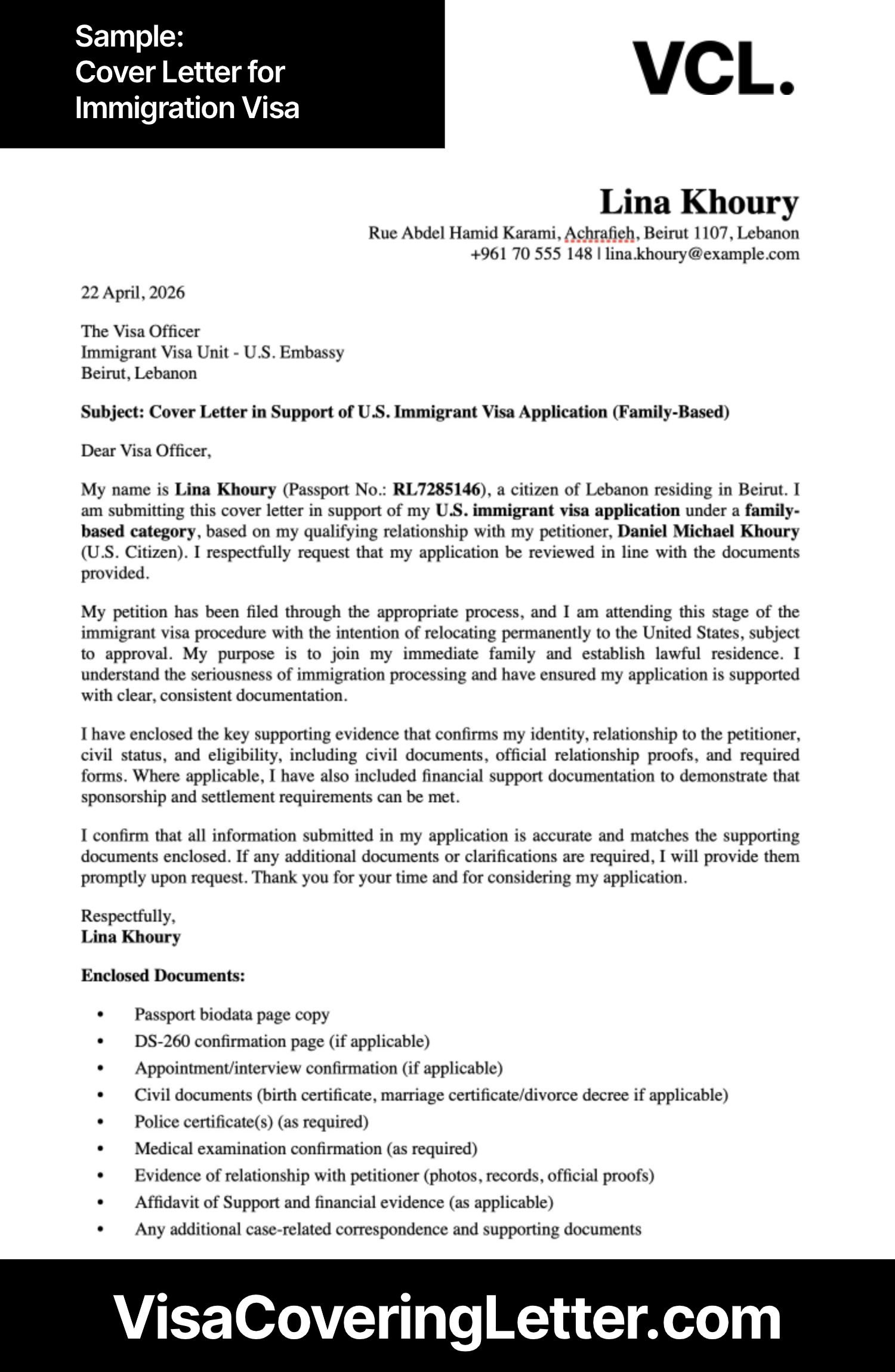
Cover letter for immigration visa sample:
Lina Khoury
Rue Abdel Hamid Karami, Achrafieh, Beirut 1107, Lebanon
+961 70 555 148 | lina.khoury@example.com
22 April, 2026
The Visa Officer
Immigrant Visa Unit – U.S. Embassy
Beirut, Lebanon
Subject: Cover Letter in Support of U.S. Immigrant Visa Application (Family-Based) Dear Visa Officer,
My name is Lina Khoury (Passport No.: RL7285146), a citizen of Lebanon residing in Beirut. I am submitting this cover letter in support of my U.S. immigrant visa application under a family based category, based on my qualifying relationship with my petitioner, Daniel Michael Khoury (U.S. Citizen). I respectfully request that my application be reviewed in line with the documents provided.
My petition has been filed through the appropriate process, and I am attending this stage of the immigrant visa procedure with the intention of relocating permanently to the United States, subject to approval. My purpose is to join my immediate family and establish lawful residence. I understand the seriousness of immigration processing and have ensured my application is supported with clear, consistent documentation.
I have enclosed the key supporting evidence that confirms my identity, relationship to the petitioner, civil status, and eligibility, including civil documents, official relationship proofs, and required forms. Where applicable, I have also included financial support documentation to demonstrate that sponsorship and settlement requirements can be met.
I confirm that all information submitted in my application is accurate and matches the supporting documents enclosed. If any additional documents or clarifications are required, I will provide them promptly upon request. Thank you for your time and for considering my application.
Respectfully,
Lina Khoury
Enclosed Documents:
- Passport biodata page copy
- DS-260 confirmation page (if applicable)
- Appointment/interview confirmation (if applicable)
- Civil documents (birth certificate, marriage certificate/divorce decree if applicable) • Police certificate(s) (as required)
- Medical examination confirmation (as required)
- Evidence of relationship with petitioner (photos, records, official proofs) • Affidavit of Support and financial evidence (as applicable)
- Any additional case-related correspondence and supporting documents
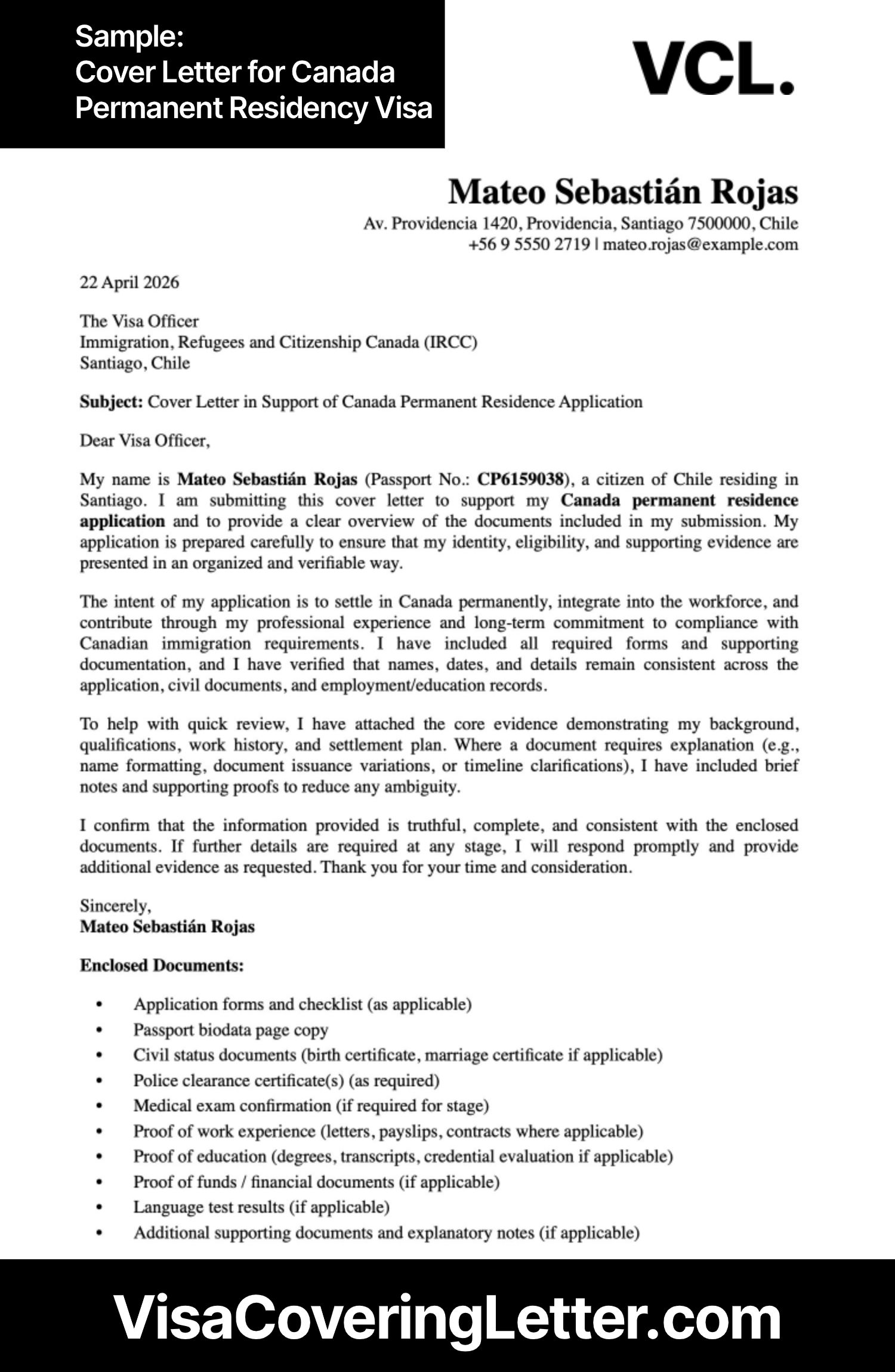
Cover letter template for canada residency (PR) visa:
Mateo Sebastián Rojas
Av. Providencia 1420, Providencia, Santiago 7500000, Chile
+56 9 5550 2719 | mateo.rojas@example.com
22 April 2026
The Visa Officer
Immigration, Refugees and Citizenship Canada (IRCC)
Santiago, Chile
Subject: Cover Letter in Support of Canada Permanent Residence Application Dear Visa Officer,
My name is Mateo Sebastián Rojas (Passport No.: CP6159038), a citizen of Chile residing in Santiago. I am submitting this cover letter to support my Canada permanent residence application and to provide a clear overview of the documents included in my submission. My application is prepared carefully to ensure that my identity, eligibility, and supporting evidence are presented in an organized and verifiable way.
The intent of my application is to settle in Canada permanently, integrate into the workforce, and contribute through my professional experience and long-term commitment to compliance with Canadian immigration requirements. I have included all required forms and supporting documentation, and I have verified that names, dates, and details remain consistent across the application, civil documents, and employment/education records.
To help with quick review, I have attached the core evidence demonstrating my background, qualifications, work history, and settlement plan. Where a document requires explanation (e.g., name formatting, document issuance variations, or timeline clarifications), I have included brief notes and supporting proofs to reduce any ambiguity.
I confirm that the information provided is truthful, complete, and consistent with the enclosed documents. If further details are required at any stage, I will respond promptly and provide additional evidence as requested. Thank you for your time and consideration.
Sincerely,
Mateo Sebastián Rojas
Enclosed Documents:
- Application forms and checklist (as applicable)
- Passport biodata page copy
- Civil status documents (birth certificate, marriage certificate if applicable) • Police clearance certificate(s) (as required)
- Medical exam confirmation (if required for stage)
- Proof of work experience (letters, payslips, contracts where applicable) • Proof of education (degrees, transcripts, credential evaluation if applicable) • Proof of funds / financial documents (if applicable)
- Language test results (if applicable)
- Additional supporting documents and explanatory notes (if applicable)
A simple “evidence map” method (so your letter stays aligned).
A practical way to stay aligned is to write one sentence per claim and tie it to evidence.
For example:
- Identity → passport + national ID
- Relationship → marriage certificate + photos + communication proof (if required)
- Sponsor evidence → sponsor status + income proof + accommodation proof
- Timeline → residence records + employment letters + travel records (if included)
Expert Note:
Officers trust files that are easy to verify. Your letter’s job is to make verification simple.

Common mistakes and precise fixes (8–12 issues).
- Mistake: Unclear category or route
Fix: State the exact route in the subject line and opening paragraph. - Mistake: Timeline doesn’t match documents
Fix: List key dates (relationship, employment, residence) and cross-check them against certificates and letters. - Mistake: Sponsor role is vague
Fix: Clarify whether the sponsor provides funds, accommodation, or both, and point to sponsor evidence. - Mistake: Too emotional, too personal
Fix: Keep tone factual; use evidence-led statements. - Mistake: Over claiming or promising outcomes
Fix: Replace “will be approved” with “I respectfully request consideration based on the enclosed evidence.” - Mistake: Leaving gaps unexplained
Fix: Briefly explain any gap using neutral language and attach supporting proof when available. - Mistake: Inconsistent names/spellings
Fix: Use passport spelling everywhere; if a name variation exists, mention it and include legal proof. - Mistake: Listing documents you didn’t attach
Fix: Only list what’s included; keep the immigration document checklist cover letter accurate. - Mistake: Missing lawful intent language
Fix: Confirm you are applying through the correct legal route and will comply with requirements. - Mistake: Confusing structure
Fix: Use headings and keep paragraphs short for scanning.
Who this approach is for (and who should get extra help).
Best for:
- Intermediate applicants assembling larger immigration files
- Family or sponsored immigration visa cases
- PR or settlement applications needing a clean evidence roadmap
Consider extra support if:
- Your case has prior refusals
- Your timeline includes long gaps with limited evidence
- Sponsorship arrangements are complex
- There are identity or civil document discrepancies
A cover letter can clarify complexity, but it cannot replace eligibility or missing legal requirements.
FAQ: cover letter for immigration visa application.
Is a cover letter mandatory for an immigration visa application?
Not always, but it is strongly recommended because it improves clarity and documents consistency across a larger file.
How long should an immigration visa cover letter be?
Typically 1–2 pages. Keep it concise, evidence-led, and easy to scan.
What should I include in an immigration cover letter?
Focus on purpose, lawful intent, background summary, timeline, sponsor evidence (if applicable), and an attachment map.
Can I use the same cover letter for PR and settlement applications?
The structure can be similar, but the wording should match your specific category and eligibility requirements.
Should I mention ties in an immigration case?
Yes, where relevant. Ties may support transparency and context, especially in family migration or sponsored immigration visa cases.
What is the biggest mistake in a cover letter for PR application?
Over claiming, vague timelines, and not aligning statements with evidence.
Do I need to attach a sponsor cover letter too?
If your route involves a sponsor, a sponsor statement is often expected. Your cover letter should reference it.
Can a cover letter prevent refusal?
No document can guarantee outcomes. However, a clear cover letter can reduce avoidable confusion and document mismatch.
Conclusion.
A strong cover letter for immigration visa application keeps your file lawful, clear, and easy to verify. Focus on transparency, a clean timeline, and strict documents consistency then map every key point to supporting evidence. Your goal is not persuasion; it’s a readable, document-aligned case.