Applying for a temporary visa can feel overwhelming, especially when embassies ask for a cover letter for non immigration visa and don’t clearly explain what they expect. Many applicants have all the right documents yet struggle to present them in a clear, consistent way.
A non-immigrant visa cover letter solves that problem. It brings your purpose of travel, itinerary, funding, and return plan into one formal explanation that visa officers can quickly understand. This guide shows you exactly how to write a strong cover letter for tourist, business, study, and transit visas, using a country-agnostic structure that works globally.
Key takeaways.
A good cover letter for non immigration visa does not persuade – it clarifies.
- Clearly state your temporary intent and purpose of travel
- Match dates, funding, and accommodation with your documents
- Use a formal, embassy-appropriate tone
- Adjust focus based on visa type (tourist, business, study, transit)
- Avoid claims you cannot prove or emotional language
Expert Note:
Industry research commonly shows that visa delays often stem from inconsistency, not missing paperwork. A clear cover letter reduces avoidable confusion.
What is a cover letter for non-immigration visa?
A non–immigration visa cover letter is a formal letter submitted with a temporary visa application. It explains:
- Why you are traveling
- How long you will stay
- Who will fund the trip
- Where you will stay
- Why you will return
Unlike immigration cases, non-immigration visas focus on short stay and return intent. Your cover letter is where that intent is clearly documented.
Non-immigration visa types covered in this guide.
This structure applies to:
- Tourist visa cover letter
- Business visa cover letter
- Study visa cover letter
- Transit visa cover letter
While embassies differ, the underlying logic remains the same: clarity, consistency, and document alignment.
Core structure that works globally.
Every cover letter for visa application should include these sections:
- Applicant identification
- Visa type and purpose
- Travel itinerary summary
- Funding proof explanation
- Employment/study ties or return plan
- Polite closing and document reference
This embassy cover letter format is simple, formal, and universally accepted.
Step-by-Step: how to write a non-immigration visa cover letter.
Step 1: Header and Applicant Details
Include full name, address, email, phone number, and passport number (if preferred).
Step 2: Embassy Address and Subject Line
Use a clear subject line such as:
Subject: Application for Non-Immigrant Visa – Tourism
Step 3: Purpose of Travel
State your reason for travel in one concise paragraph. Avoid vague wording.
Step 4: Itinerary Summary
Explain dates, cities, accommodation, and mode of travel. This is the core of a cover letter for tourist visa itinerary or transit case.
Step 5: Funding Explanation
Clarify whether the trip is self-funded or sponsored. Reference bank statements or sponsor documents.
Step 6: Return Plan
Explain employment, studies, or family obligations that require your return.
Step 7: Closing
Confirm accuracy, compliance, and willingness to provide further information.
How the focus changes by visa type.
Tourist Visa Cover Letter
Focus on leisure purpose, short stay, accommodation plan, and self-funding.
Business Visa Cover Letter
Focus on meetings, events, invitation letter (if applicable), and employer support.
Study Visa Cover Letter
Focus on admission details, program duration, funding, and academic intent.
Transit Visa Cover Letter
Focus on onward travel, short duration, and confirmed tickets.
What to emphasize by visa type.
| Visa Type | Primary Focus | Supporting Proof |
| Tourist | Leisure purpose, itinerary | Hotel, flights, bank statements |
| Business | Meetings/events | Invitation letter, employer letter |
| Study | Temporary study intent | Admission letter, funding proof |
| Transit | Short stopover | Onward ticket, visa for destination |
Pros and trade-offs of using a cover letter.
Pros
- Improves clarity for visa officers
- Reduces document misinterpretation
- Helps beginners present a structured case
Trade-Offs
- Cannot fix missing eligibility
- Must be accurate – errors weaken the file
A visa cover letter generator can help with structure, but accuracy always depends on your inputs.

Common mistakes and how to fix them.
- Mismatch in travel dates → Cross-check itinerary and bookings
- Unclear funding source → Explicitly state who pays and how
- Emotional language → Use factual, formal tone
- Overlong letters → Keep it to one page
- Missing return plan → Always explain ties
Common refusal triggers vs fixes.
| Common Trigger | How the Cover Letter Helps |
| Doubt about return intent | Explains employment/study ties |
| Funding concerns | References bank statements clearly |
| Confusing itinerary | Provides concise itinerary summary |
| Inconsistent documents | Aligns dates and purpose |
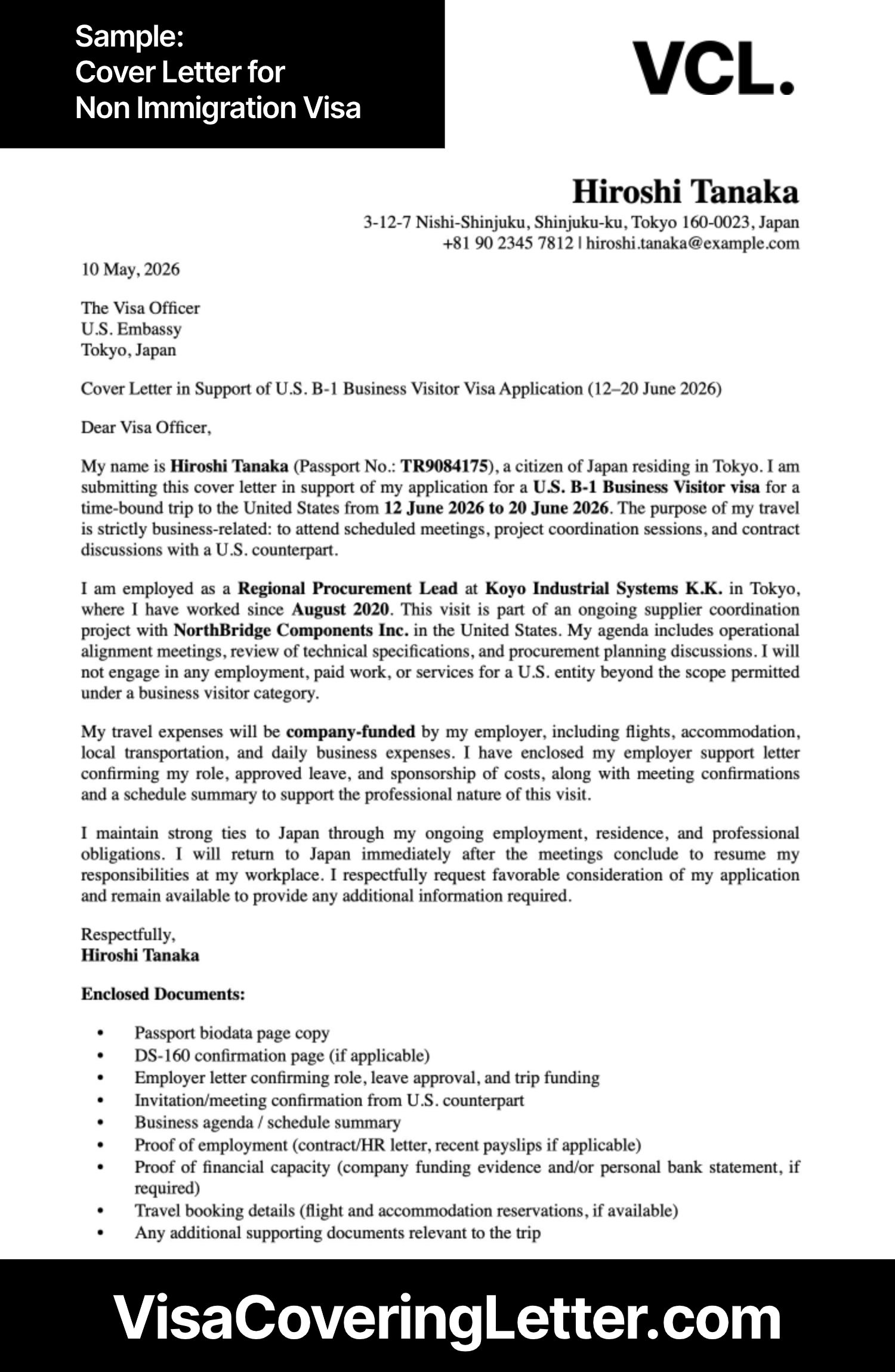
Cover letter for non immigration visa sample:
Hiroshi Tanaka
3-12-7 Nishi-Shinjuku, Shinjuku-ku, Tokyo 160-0023, Japan
+81 90 2345 7812 | hiroshi.tanaka@example.com
10 May, 2026
The Visa Officer
U.S. Embassy
Tokyo, Japan
Cover Letter in Support of U.S. B-1 Business Visitor Visa Application (12–20 June 2026) Dear Visa Officer,
My name is Hiroshi Tanaka (Passport No.: TR9084175), a citizen of Japan residing in Tokyo. I am submitting this cover letter in support of my application for a U.S. B-1 Business Visitor visa for a time-bound trip to the United States from 12 June 2026 to 20 June 2026. The purpose of my travel is strictly business-related: to attend scheduled meetings, project coordination sessions, and contract discussions with a U.S. counterpart.
I am employed as a Regional Procurement Lead at Koyo Industrial Systems K.K. in Tokyo, where I have worked since August 2020. This visit is part of an ongoing supplier coordination project with NorthBridge Components Inc. in the United States. My agenda includes operational alignment meetings, review of technical specifications, and procurement planning discussions. I will not engage in any employment, paid work, or services for a U.S. entity beyond the scope permitted under a business visitor category.
My travel expenses will be company-funded by my employer, including flights, accommodation, local transportation, and daily business expenses. I have enclosed my employer support letter confirming my role, approved leave, and sponsorship of costs, along with meeting confirmations and a schedule summary to support the professional nature of this visit.
I maintain strong ties to Japan through my ongoing employment, residence, and professional obligations. I will return to Japan immediately after the meetings conclude to resume my responsibilities at my workplace. I respectfully request favorable consideration of my application and remain available to provide any additional information required.
Respectfully,
Hiroshi Tanaka
Enclosed Documents:
- Passport biodata page copy
- DS-160 confirmation page (if applicable)
- Employer letter confirming role, leave approval, and trip funding
- Invitation/meeting confirmation from U.S. counterpart
- Business agenda / schedule summary
- Proof of employment (contract/HR letter, recent payslips if applicable) • Proof of financial capacity (company funding evidence and/or personal bank statement, if required)
- Travel booking details (flight and accommodation reservations, if available) • Any additional supporting documents relevant to the trip
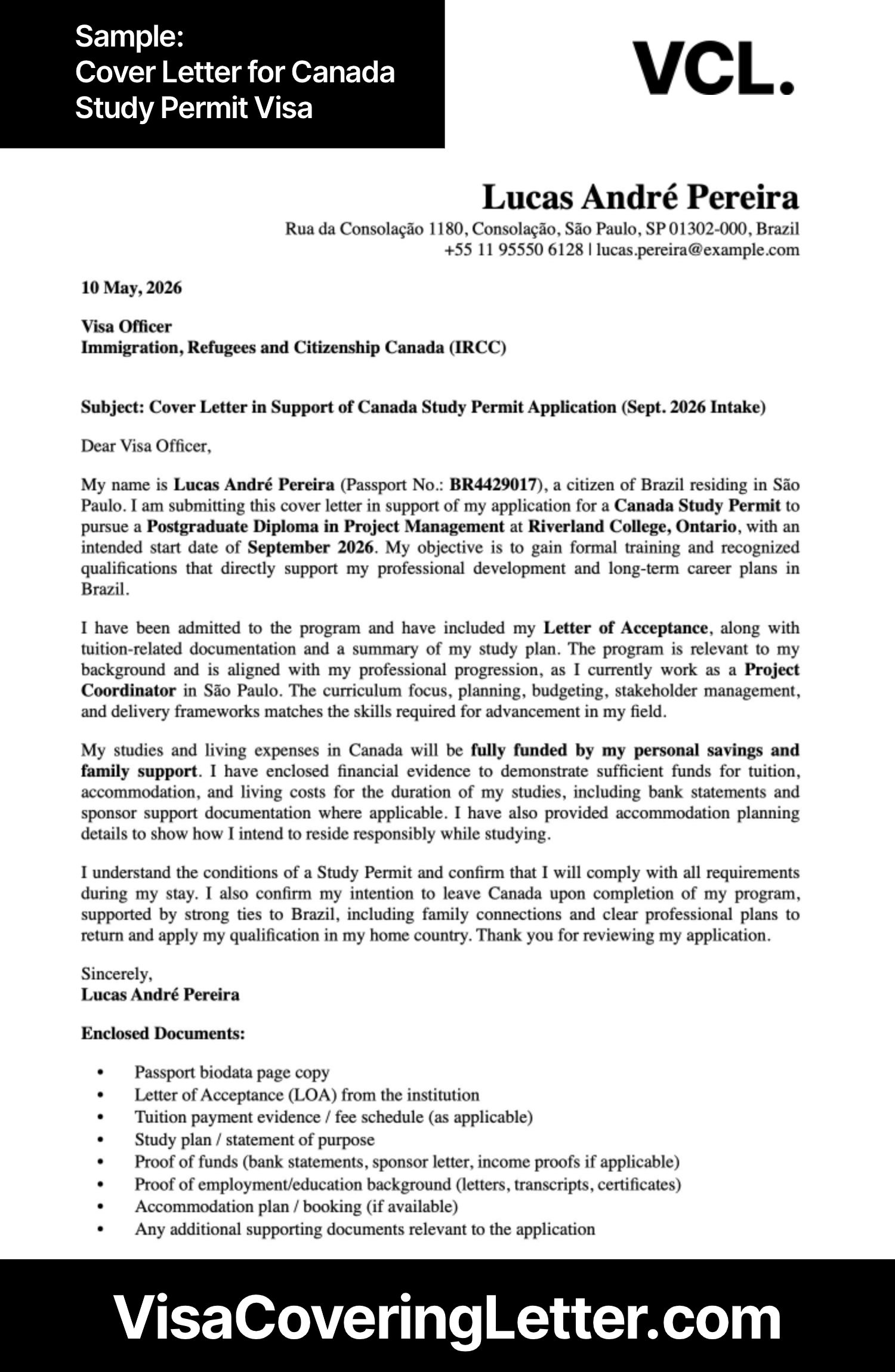
Cover letter sample for canadian study permit (PR) visa:
Lucas André Pereira
Rua da Consolação 1180, Consolação, São Paulo, SP 01302-000, Brazil
+55 11 95550 6128 | lucas.pereira@example.com
10 May, 2026
Visa Officer
Immigration, Refugees and Citizenship Canada (IRCC)
Subject: Cover Letter in Support of Canada Study Permit Application (Sept. 2026 Intake) Dear Visa Officer,
My name is Lucas André Pereira (Passport No.: BR4429017), a citizen of Brazil residing in São Paulo. I am submitting this cover letter in support of my application for a Canada Study Permit to pursue a Postgraduate Diploma in Project Management at Riverland College, Ontario, with an intended start date of September 2026. My objective is to gain formal training and recognized qualifications that directly support my professional development and long-term career plans in Brazil.
I have been admitted to the program and have included my Letter of Acceptance, along with tuition-related documentation and a summary of my study plan. The program is relevant to my background and is aligned with my professional progression, as I currently work as a Project Coordinator in São Paulo. The curriculum focus, planning, budgeting, stakeholder management, and delivery frameworks matches the skills required for advancement in my field.
My studies and living expenses in Canada will be fully funded by my personal savings and family support. I have enclosed financial evidence to demonstrate sufficient funds for tuition, accommodation, and living costs for the duration of my studies, including bank statements and sponsor support documentation where applicable. I have also provided accommodation planning details to show how I intend to reside responsibly while studying.
I understand the conditions of a Study Permit and confirm that I will comply with all requirements during my stay. I also confirm my intention to leave Canada upon completion of my program, supported by strong ties to Brazil, including family connections and clear professional plans to return and apply my qualification in my home country. Thank you for reviewing my application.
Sincerely,
Lucas André Pereira
Enclosed Documents:
- Passport biodata page copy
- Letter of Acceptance (LOA) from the institution
- Tuition payment evidence / fee schedule (as applicable)
- Study plan / statement of purpose
- Proof of funds (bank statements, sponsor letter, income proofs if applicable) • Proof of employment/education background (letters, transcripts, certificates) • Accommodation plan / booking (if available)
- Any additional supporting documents relevant to the application
Tools and Resources to Prepare Before Writing
Have these ready:
- Passport details
- Travel dates and itinerary
- Accommodation plan
- Funding proof or sponsor documents
This ensures your cover letter structure stays consistent.
Who this is for (and who should avoid).
Best for:
- First-time applicants
- Short-stay travelers
- Family visit or sponsored cases
Consider extra help if:
- You have prior refusals
- Your funding is complex
- Documents conflict
Frequently asked questions.
What is a cover letter for non immigration visa?
It is a formal explanation of temporary intent, purpose, itinerary, and funding.
Is it mandatory?
Not always, but highly recommended for clarity.
How long should it be?
Usually one page (300–400 words).
Can I reuse the same letter for different visas?
Structure can be reused; content must change.
Should I mention a sponsor?
Yes, if someone else is funding the trip.
Does a cover letter guarantee approval?
No. It only improves clarity and consistency.
Conclusion.
A clear cover letter for non immigration visa helps embassies quickly understand your temporary intent, itinerary, and funding. Keep it factual, aligned with documents, and visa-specific—and you’ll submit a stronger, more organized application.