
A study visa application is more than a checklist of documents. Behind every acceptance letter and bank statement, embassies look for consistency, intent, and clarity. That is exactly where a well-written cover letter for study visa application becomes essential.
For many students, this letter is the first and only place where their academic plans, funding, and future goals come together in one clear explanation. When written correctly, it aligns your admission file with your visa request and helps the visa officer quickly understand why you are studying, how you will support yourself, and what you plan to do afterward.
This guide explains how to write a study visa cover letter that truly supports your application not just formally, but strategically.
Key takeaways.
A strong study visa cover letter does three things at once.
It explains your academic purpose, confirms that your documents are consistent, and reassures the embassy that your study plan is genuine.
Your letter should be one page, formal, factual, and fully aligned with your admission letter, financial proof, and program duration. It should never introduce surprises or contradictions.
What is a study visa cover letter and why it matters.
A student visa cover letter is a formal document addressed to the embassy or consulate where you apply for your visa. It summarizes your study plans and explains how your admission, funding, and background fit together.
Unlike a motivation letter written for a university, this letter is written for a visa officer, not an academic committee. The focus is not passion alone, but credibility and compliance.
Visa officers often use the cover letter to:
- Understand your study plan without reading every document in detail
- Cross-check key facts like program duration, funding source, and accommodation
- Assess whether your application is complete and logical
When documents are strong but poorly explained, applications can still be delayed or questioned. A clear cover letter reduces that risk.
How the study visa cover letter supports your admission file.
Your admission letter states that you were accepted.
Your cover letter explains why that acceptance makes sense.
A good cover letter connects:
- Your academic background → your chosen program
- Your program duration → your visa type (short-term or long stay)
- Your funding → your living and tuition costs
- Your study plan → your future career direction
When these elements match perfectly, your file appears well-prepared and trustworthy.
Step-by-Step: how to write a cover letter for study visa application.
Step 1: Start With Proper Header and Embassy Details
Begin with your full name, address, email, phone number, and passport number. Below that, add the embassy or consulate name and address, followed by the date.
This sets a formal and professional tone from the start.
Step 2: Write a Clear Subject Line
Your subject line should immediately tell the officer what the letter is about.
For example:
Subject: Application for Study Visa – Master’s Program (September 2026 Intake)
Avoid vague subjects like “Visa Application” or “Student Visa Request.”
Step 3: Introduce Yourself and State Your Purpose
In the opening paragraph, briefly explain who you are and why you are applying.
Mention:
- Your nationality
- The program name
- The institution
- The start date
This paragraph should be factual and concise, not emotional.
Step 4: Explain Your Study Program and Duration
This section must match your admission letter exactly.
Explain:
- The full name of the program
- Whether it is undergraduate, master’s, PhD, or language course
- The total duration
If your program leads to a long-term stay, this is where you justify the long stay study visa cover letter requirement.
Step 5: Address Your Academic Background
Briefly explain how your previous education connects to the program you are pursuing.
You are not rewriting your CV. You are simply showing logical academic progression so the visa officer understands why this program fits you.
Step 6: Explain Funding and Financial Proof
This is one of the most critical parts of the letter.
State clearly:
- Who is funding your studies (self, parents, sponsor, scholarship)
- What documents prove this (bank statements, scholarship letters, affidavits)
If you are a scholarship student, mention the scholarship name and coverage. If family-sponsored, explain the relationship briefly.
Step 7: Mention Accommodation and Living Arrangements
Indicate where you will live during your studies.
This can include:
- University dormitory
- Private rental
- Family accommodation
Your explanation should match the accommodation proof submitted.
Step 8: Address Career Plan and Return Intent (Where Relevant)
Some countries expect students to show intent to return after studies, while others focus more on compliance.
If applicable, briefly explain how this program fits into your long-term career plans and how it connects to your home country.
Do not overpromise or make unrealistic claims. Keep it practical.
Step 9: Close the Letter Professionally
End by confirming that all documents are attached and thanking the officer for their time.
Sign the letter with your full name.
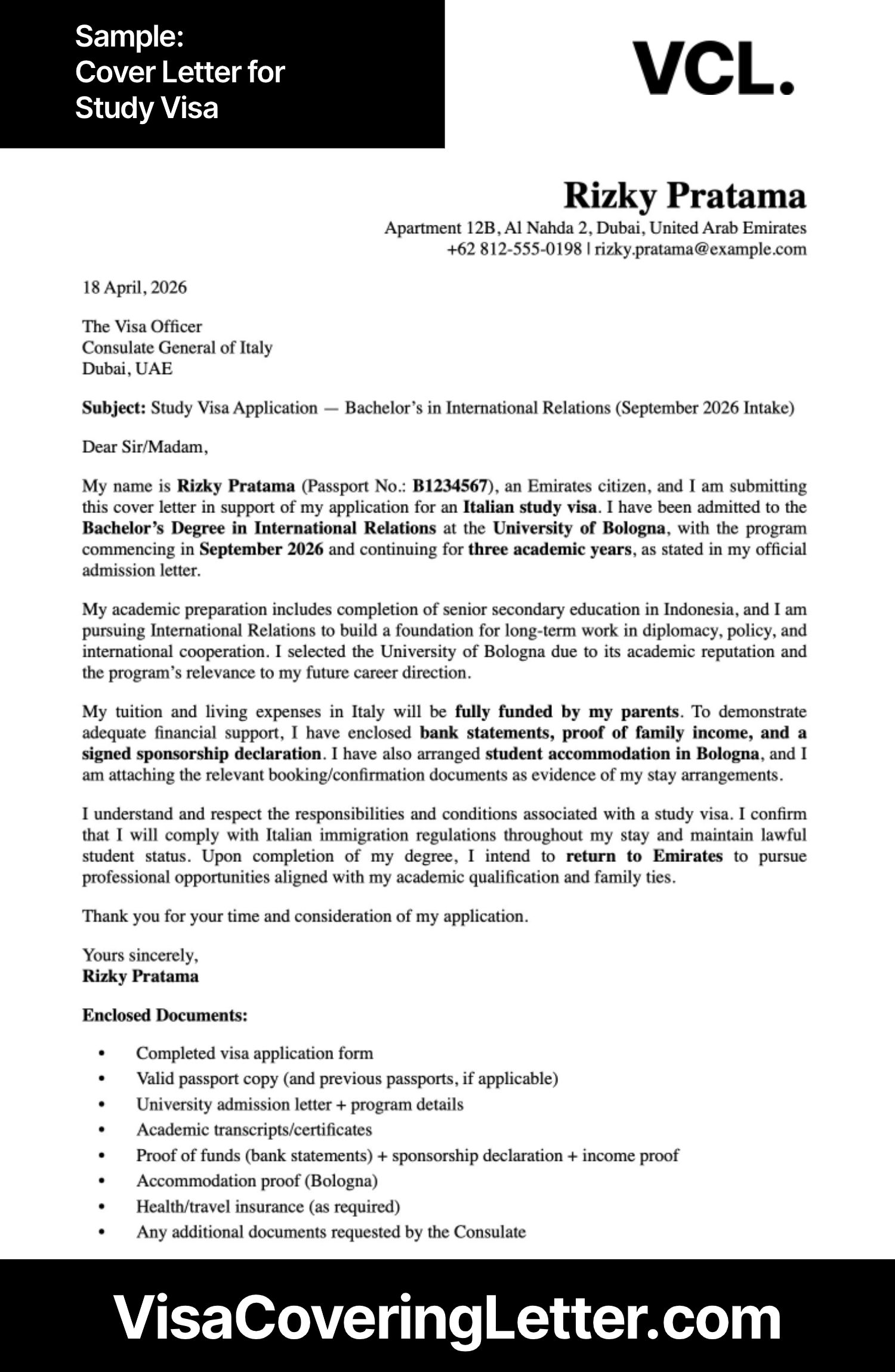
Cover letter for study visa sample:
Rizky Pratama
Apartment 12B, Al Nahda 2, Dubai, United Arab Emirates
+62 812-555-0198 | rizky.pratama@example.com
18 April, 2026
The Visa Officer
Consulate General of Italy
Dubai, UAE
Subject: Study Visa Application — Bachelor’s in International Relations (September 2026 Intake) Dear Sir/Madam,
My name is Rizky Pratama (Passport No.: B1234567), an Emirates citizen, and I am submitting this cover letter in support of my application for an Italian study visa. I have been admitted to the Bachelor’s Degree in International Relations at the University of Bologna, with the program commencing in September 2026 and continuing for three academic years, as stated in my official admission letter.
My academic preparation includes completion of senior secondary education in Indonesia, and I am pursuing International Relations to build a foundation for long-term work in diplomacy, policy, and international cooperation. I selected the University of Bologna due to its academic reputation and the program’s relevance to my future career direction.
My tuition and living expenses in Italy will be fully funded by my parents. To demonstrate adequate financial support, I have enclosed bank statements, proof of family income, and a signed sponsorship declaration. I have also arranged student accommodation in Bologna, and I am attaching the relevant booking/confirmation documents as evidence of my stay arrangements.
I understand and respect the responsibilities and conditions associated with a study visa. I confirm that I will comply with Italian immigration regulations throughout my stay and maintain lawful student status. Upon completion of my degree, I intend to return to Emirates to pursue professional opportunities aligned with my academic qualification and family ties.
Thank you for your time and consideration of my application.
Yours sincerely,
Rizky Pratama
Enclosed Documents:
- Completed visa application form
- Valid passport copy (and previous passports, if applicable)
- University admission letter + program details
- Academic transcripts/certificates
- Proof of funds (bank statements) + sponsorship declaration + income proof • Accommodation proof (Bologna)
- Health/travel insurance (as required)
- Any additional documents requested by the Consulate
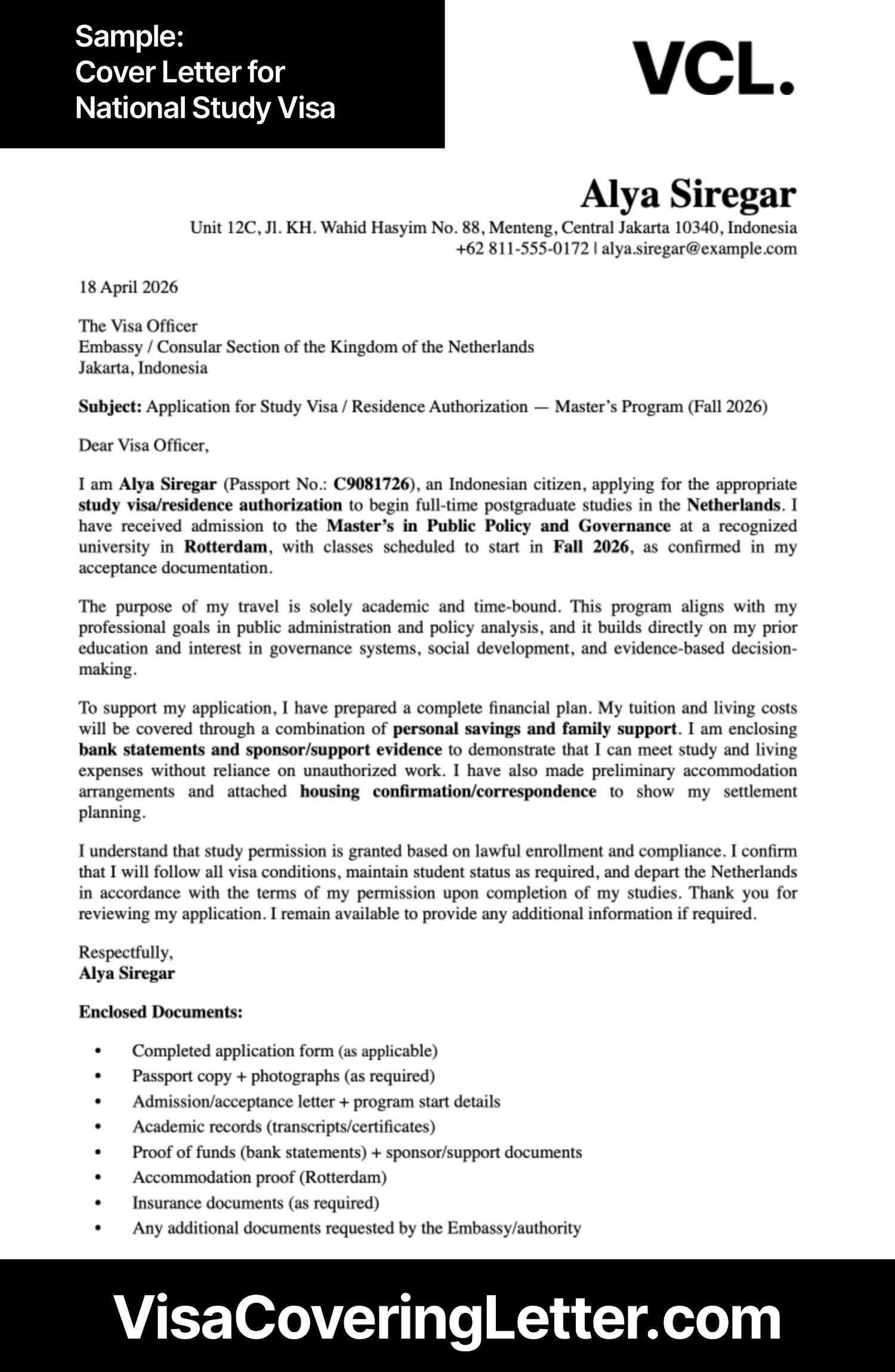
Cover letter template for national (long-stay) study visa:
Alya Siregar
Unit 12C, Jl. KH. Wahid Hasyim No. 88, Menteng, Central Jakarta 10340, Indonesia +62 811-555-0172 | alya.siregar@example.com
18 April 2026
The Visa Officer
Embassy / Consular Section of the Kingdom of the Netherlands
Jakarta, Indonesia
Subject: Application for Study Visa / Residence Authorization — Master’s Program (Fall 2026) Dear Visa Officer,
I am Alya Siregar (Passport No.: C9081726), an Indonesian citizen, applying for the appropriate study visa/residence authorization to begin full-time postgraduate studies in the Netherlands. I have received admission to the Master’s in Public Policy and Governance at a recognized university in Rotterdam, with classes scheduled to start in Fall 2026, as confirmed in my acceptance documentation.
The purpose of my travel is solely academic and time-bound. This program aligns with my professional goals in public administration and policy analysis, and it builds directly on my prior education and interest in governance systems, social development, and evidence-based decision making.
To support my application, I have prepared a complete financial plan. My tuition and living costs will be covered through a combination of personal savings and family support. I am enclosing bank statements and sponsor/support evidence to demonstrate that I can meet study and living expenses without reliance on unauthorized work. I have also made preliminary accommodation arrangements and attached housing confirmation/correspondence to show my settlement planning.
I understand that study permission is granted based on lawful enrollment and compliance. I confirm that I will follow all visa conditions, maintain student status as required, and depart the Netherlands in accordance with the terms of my permission upon completion of my studies. Thank you for reviewing my application. I remain available to provide any additional information if required.
Respectfully,
Alya Siregar
Enclosed Documents:
- Completed application form (as applicable)
- Passport copy + photographs (as required)
- Admission/acceptance letter + program start details
- Academic records (transcripts/certificates)
- Proof of funds (bank statements) + sponsor/support documents
- Accommodation proof (Rotterdam)
- Insurance documents (as required)
- Any additional documents requested by the Embassy/authority
Why this structure works for visa officers.
This format works because it mirrors how visa officers review files. They look for consistency first, then credibility.
A structured letter helps them verify details quickly without searching through multiple documents. It also reduces the risk of misunderstandings, especially in cases involving funding or long-term study.
Common mistakes students make (and how to fix them).
One common mistake is writing a motivational essay instead of a visa letter. Visa officers are not evaluating passion; they are evaluating eligibility.
Another issue is mismatch. Dates in the letter that differ from the admission letter, or funding explanations that do not match bank statements, can raise concerns.
Students also sometimes omit accommodation details or forget to mention scholarships even when documents are included. If it supports your application, it should be mentioned clearly.
Finally, avoid informal language. This is an official document, not a personal email.
Using templates and generators carefully.
Many students use a visa cover letter generator or sample PDFs as a starting point. This is fine, as long as you customize every section.
A template should provide structure, not content. Your admission details, funding source, and study plan must always be unique to you.

Frequently asked questions.
Is a cover letter mandatory for study visa applications?
Some embassies require it, others strongly recommend it. Even when optional, it significantly improves clarity.
How long should a study visa cover letter be?
One page is ideal. Usually between 300 and 400 words.
Is this the same as a statement of purpose?
No. A statement of purpose is for the university. A visa cover letter is for the embassy.
Should I mention my scholarship in the letter?
Yes. Always explain scholarships clearly and attach proof.
Can parents write the cover letter for me?
No. The applicant should write and sign it, even if parents are funding the studies.
Should I explain my future career plans?
Briefly, if relevant. Do not write a long career essay.
Can I reuse the same letter for another country?
No. Each embassy has different expectations and visa types.
Do I need to notarize the letter?
No. A signed, typed letter is sufficient.
Should I attach the cover letter on top of the application?
Yes. Place it as the first document in your visa file.
Conclusion.
A well-written cover letter for study visa application brings order and clarity to your entire file. When your admission letter, funding, and study plan are explained in one clear narrative, visa officers can assess your case with confidence.
Focus on accuracy, consistency, and professionalism—and let your documents speak together, not separately.